The Duke Office of Government Relations (OGR) and Duke Health Government Relations are closely monitoring budget negotiations in Washington to assess the implications of a possible partial federal government shutdown for Duke and its activities. If such a shutdown occurs, it will take effect at 12:01 a.m. on Saturday, January 31, 2026.
To date, six of the twelve annual appropriations bills have been signed into law, and federal agencies funded through those bills would operate under normal circumstances should a shutdown occur. The agencies without a final appropriation for FY 26 that a partial shutdown could impact include:
Department of Education
Department of Health and Human Services
Department of Homeland Security
Department of State
Department of Transportation
Department of Defense
The OGR is closely coordinating with several key offices, including the Offices for Research and Innovation and Finance, to provide updates to the Duke community and to outline contingencies in place should a shutdown occur. We will continue to monitor developments and communications from the federal agencies. Still, it is possible that official guidance will not be available until after the shutdown begins. As information becomes available, it will be accessible through Duke Today, the Office of Government Relations blog, and the live updates page of myRESEARCHpath. The current expectation is that any partial shutdown would be short-term. Duke Health Government Relations will inform health system leadership about the implications of a shutdown for patients, clinical trials, hospital operations, and medical and nursing education. As with previous shutdowns, we anticipate that Social Security and Medicare checks, as well as Medicare payments to hospitals, physicians, and other providers, will continue to be distributed. However, there is a patchwork of temporary statutory waivers for telehealth services under Medicare that, unless further action is taken, will expire on January 30. Duke Health Government Relations continues to advocate for the extension of telehealth waivers and any retroactive payments that may be due.
Below are some additional resources that will be helpful if a shutdown occurs:
As part of the Office of Government Relations’ ongoing work to track federal policy developments affecting the Duke community, this update provides a high-level review of legislative and administrative activity over the past several months. The summary below builds on earlier OGR coverage and highlights more recent developments across budget and appropriations, research, student aid, immigration, tax, and broader policy engagement.
Budget and Appropriations
Last fall marked the longest shutdown in U.S. history, lasting 35 days. Congress ended the shutdown by enacting a short-term funding package that extends most government operations through January 30, 2026, while providing full-year funding for the Agriculture–FDA, Legislative Branch, and Military Construction–Veterans Affairs. Additional context on the shutdown and its resolution is available in OGR’s earlier coverage.
Since then, appropriators have resumed work on the remaining FY26 bills. In early December, Senate leaders moved closer to advancing a five-bill minibus that would include Labor–HHS–Education, Defense, Transportation–HUD, Interior–Environment, and Commerce–Justice–Science, though objections within the Republican conference delayed floor action. The Senate ultimately failed to move anything forward before the holiday break, with Majority Leader John Thune (R-SD) and Minority Leader Chuck Schumer (D-NY) stating they agreed on advancing funding bills when the Senate reconvened.
Once Congress returned from the holiday break, lawmakers released the negotiated agreement for a three-bill “minibus,” which includes the Commerce-Justice-Science, Energy-Water, and Interior-Environment bills. The House is expected to take up the measure later this week. The chart below outlines the current funding status of several programs of interest to the Duke community. It illustrates Congress’s efforts to push back on the dramatic cuts to research and education programs proposed by the administration. Negotiations are expected to continue on the remaining FY26 measures ahead of the January 30 funding deadline.
Research
Building on developments OGR has tracked throughout the year, federal research policy continues to be shaped by a mix of administrative priorities, congressional action, and litigation.
Earlier OGR coverage summarized the administration’s FY27 research and development priorities, as well as a series of agency actions affecting grantmaking, indirect cost policies, and research oversight.
Congress passed, and President Donald Trump signed into law, the FY26 National Defense Authorization Act (NDAA) just before the end of the year. More details on provisions of interest, including top-line budget numbers, indirect cost rates, and other relevant information, were covered in a previous DC Digest.
Other recent activities have largely reinforced these trends, as OGR continues to monitor agencies implementing guidance and courts issuing decisions that affect research funding, including facilities and administrative costs. In September, Commerce Secretary Howard Lutnick proposed imposing a 50 percent innovation tax on revenues universities earn from licensing their discoveries to the private sector. Although no concrete action is currently scheduled on this proposal, OGR is closely monitoring this issue and will provide updates as needed.
Following the developments in student aid covered earlier, federal activity in this area has accelerated through both negotiated rulemaking and congressional engagement.
OGR previously summarized major student aid provisions enacted under reconciliation and early signals from the Department of Education regarding implementation. We have also covered the Congressional response to proposed limits on graduate lending for medical professions in detail.
More recently, the Accountability in Higher Education and Access through Demand-driven Workforce Pell (AHEAD) Committee reached consensus on the Department’s complete package of proposals discussed during its first negotiated rulemaking session, which primarily focuses on establishing a new Workforce Pell program. The consensus package addresses program classification, value-added earnings calculations, completion and placement metrics, and clarifications regarding eligibility and program purpose.
Relatedly, though not part of the negotiated rulemaking session, the Department introduced a new earnings indicator within the FAFSA process that alerts students when graduates of a listed institution earn less than a typical high school graduate, based on College Scorecard data. The Department has released additional information, including a list of institutions identified under the new indicator.
The AHEAD committee has reconvened for its second session, which will focus on additional issues enacted under reconciliation, including accountability measures, financial value transparency, and gainful employment and Pell eligibility exclusions tied to high Student Aid Index values.
In other recent student aid news, the House Committee on Education and the Workforce has advanced several higher education bills related to financial aid award letters and college cost transparency. While no floor votes are currently scheduled, the activity reflects continued congressional interest in cost and value disclosure issues.
Immigration
As previously detailed in our blog, immigration policy developments over the past year have continued to affect international students, scholars, and employees across higher education.
Since that coverage, U.S. Citizenship and Immigration Services (USCIS) announced new rules that shorten the time foreign workers may remain employed in the United States before renewing their work permits. Under the changes, refugees, asylees, and several other non-citizen groups must seek reauthorization every 18 months or less, with some facing annual renewals.
In addition, the Department of State implemented new procedures for vetting the online presence of H-1B and H-4 visa applicants, expanding screening practices previously applied to F, M, and J visa categories. President Trump has also expanded the list of entry restrictions, adding 20 countries to the list, which now includes 39 nations under full or partial bans.
Looking ahead, the Department of Homeland Security is preparing a proposed rule that would significantly revise the Optional Practical Training program. The rule, listed on the regulatory agenda, is expected to address oversight, fraud prevention, and national security considerations, with publication anticipated in early 2026. Other immigration-related rules affecting H-1B visas and duration of status remain pending.
Tax
Federal tax policy affecting higher education has continued to evolve through both legislation and agency guidance.
As covered previously by OGR, reconciliation legislation revised the higher education endowment tax by adjusting institutional thresholds and creating tiered tax rates. The Senate’s version reshapes the tax on large university endowments:
Exempts schools with fewer than 3,000 tuition-paying students, up from the House’s 500-student threshold.
Introduces a tiered tax structure with rates from 1.4% to 8%, depending on endowment size.
In early January, the Treasury Department will begin developing regulations that will govern the tax changes and issue final rules later in 2026.
Policy Engagement
Throughout the year, the Duke community actively engaged with policymakers both in Washington, D.C. and on campus, through a diverse set of programs, convenings, and meetings. These activities drew expertise from all parts of the university, working to build purposeful partnerships with lawmakers, think tanks, and policy professionals to elevate Duke’s presence and impact in D.C.
Among the D.C. engagement, Duke faculty and staff brought their expertise directly to policymakers on the Hill, including Dr. Emily Edwards with the Duke Quantum Center, who hosted a briefing with other academic leaders on the basics of quantum science. The leadership of the Triangle Universities Nuclear Laboratory (TUNL) visited Capitol Hill to highlight the importance of federal funding to the work at TUNL and the development of the future nuclear workforce. Also on the Hill, Dr. Ashley Ward held a briefing highlighting the efforts of the Nicholas Institute Heat Policy Innovation Hub. The briefing included opening remarks from Senator Mark Kelly (D-AZ).
Professors Dan Scolnic and Michael Troxel, assistant professors of Duke’s physics department, visited several offices in the North Carolina delegation to discuss the Roman Space Telescope mission.
Among engagements in Durham, several lawmakers connected with campus both through in-person visits and virtual remarks. Congressman Greg Murphy (NC-03) took a tour of the Duke School of Medicine and learned more about its efforts statewide to expand patient care and access, as well as the North Carolina’s first and only freestanding children’s hospital.
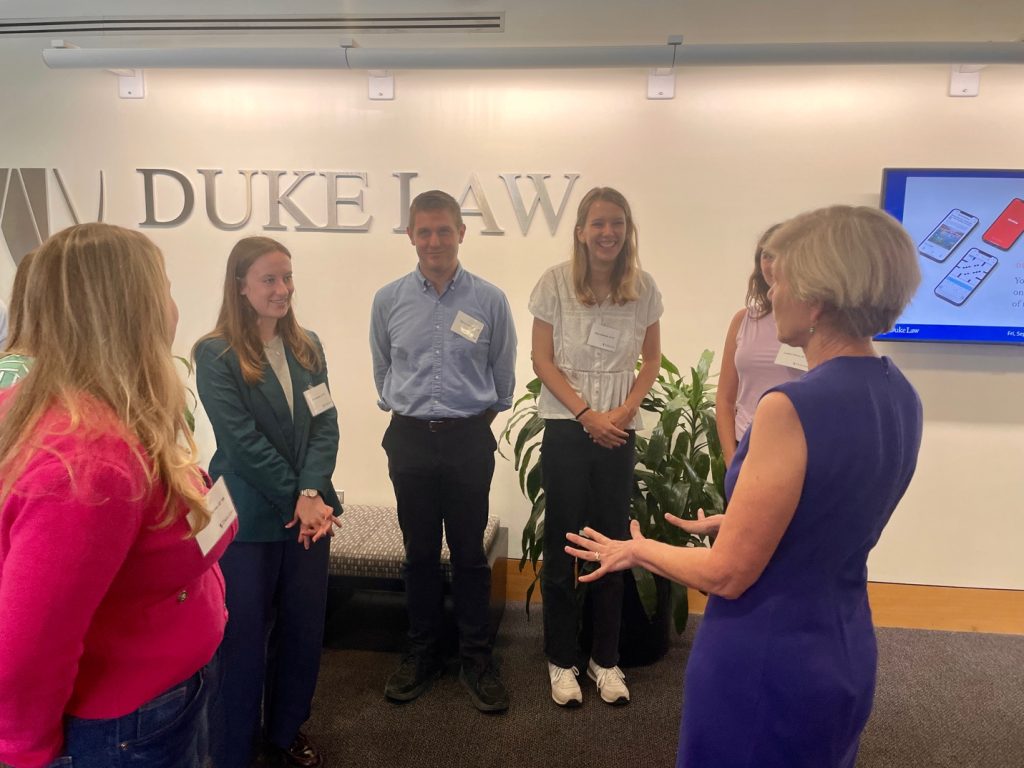
Congresswoman Deborah Ross (NC-02) paid a visit to one of Duke’s NIH-funded research labs, met with President Vincent Price and lunched with Duke Law students.
Duke’s own representative, Congresswoman Valerie Foushee (NC-04), provided welcome remarks at this year’s inaugural Athena Summit, which showcased Duke’s leadership in artificial intelligence and edge computing
What’s Next?
The Office of Government Relations will continue to monitor all aspects of federal policy activity of interest to Duke. To receive regular updates from our office, sign up for our DC Digest here.
As part of the Office of Government Relations’ ongoing series tracking federal policy areas of interest to the Duke community, this update summarizes recent federal actions shaping the national research landscape.
Administration and Agency Actions
Federal agencies have undertaken a series of policy shifts and operational changes affecting universities and other research institutions.
Most recently, the Office of Management and Budget and the Office of Science and Technology Policy released the administration’s FY27 R&D budget priorities, outlining a sharpened focus on artificial intelligence, quantum information science, semiconductors, next-generation energy technologies and research infrastructure. These priorities frame agency planning heading into the next fiscal year and signal continued emphasis on U.S. competitiveness and mission-aligned research.
The administration continued to issue a number of executive orders that impacted the nation’s research enterprise. These include the following:
Federal research agencies have also undergone restructuring and personnel changes over the second half of this year. The Department of Energy recently released its new reorganization plan, which prioritizes nuclear energy and critical minerals and shifts focus away from clean energy programs. In May, news broke about a possible restructuring plan at the National Science Foundation (NSF) that would reduce its Senior Executive Service personnel and outside “rotators”, eliminate and cancelling a substantial number of active research grants as part of a broader workforce and management overhaul.
At the National Institutes of Health (NIH), Director Jay Bhattacharya directed staff to review all grants, contracts and training programs to ensure alignment with current priorities and timely obligation of FY funds. This follows several related policy actions over the past year, including:
The implementation of temporary emergency modifications to peer review procedures in late November addressing operational challenges stemming from the shutdown period.
Congressional Activity
Congress remains actively engaged on research-related appropriations and oversight. At the time of this update, the final FY 2026 National Defense Authorization Act has passed the House of Representatives and is awaiting final approval by the Senate before heading to President Trump for signature. The legislation includes the following provisions of interest to the Duke community.
Authorizes $2.3 billion for basic research, $73 million above the FY 26 budget request
Prohibits the modification of indirect cost rates for higher education institutions and nonprofit organizations without prior consultation with those groups.
Extends existing limits on federal support for certain international research collaborations
Directs the Department of Defense (DOD) to assess the potential creation of incubator programs to support secure research facilities and networks at universities.
Notably, the conference agreement does not include the SAFE Research Act, which was included in the House version and would prohibited federal research agencies from funding researchers who collaborate with “foreign adversaries.”
Negotiations on the FY 2026 appropriations bills restarted after the 43-day government shutdown. Although the endgame for the FY 26 budget remains unclear, of note for the research community is Congress’s rejection of the drastic cuts to federal research budget proposed under the administration’s budget request. Also, appropriations bills with jurisdiction over the federal science agencies contain some version of language that would block the administration from unilaterally changing or reducing negotiated facilities and administrative (F&A) costs for universities.
The reauthorization of the SBIR/STTR programs has stalled in Congress, and the program authority officially expired on September 30, resulting in a lapse in funding. Negotiations are currently centered on passing a simple, clean reauthorization of the programs versus moving forward with an overhaul of the programs.
Court Decisions Affecting Research Funding
A series of high-impact court rulings continues to shape agency grantmaking practices and indirect cost policies central to university research operations.
NIH and NSF Grant Terminations
A federal judge ordered NIH to restore roughly $500 million in suspended UCLA research funds, finding the freezes “likely arbitrary and capricious.”
The Supreme Court allowed the administration to proceed with nearly $800 million in NIH grant reductions while legal challenges continue.
A separate federal case challenging NSF’s termination of more than $1 billion in DEI-related grants will move forward, though the judge declined to reinstate funding at this stage.
Indirect Cost Policies
The 1st U.S. Circuit Court of Appeals heard arguments over NIH’s 15 percent indirect cost cap, with judges expressing skepticism about DOJ’s jurisdiction arguments and citing congressional language barring “modified” F&A approaches.
A federal district court vacated the DOD’s indirect cost cap as unlawful; an appeal is expected.
The NSF subsequently withdrew its appeal in its own indirect-cost litigation, making the district court’s vacatur of NSF’s 15 percent cap final.
Research Community andCoalition Advocacy
Several coalitions in which Duke participates have recently issued statements or letters in support of robust federal research funding. The Energy Sciences Coalition sent a letter to leaders at the Office of Management and Budget and the Office of Science and Technology Policy requesting no less than $9.5 billion for the DOE Office of Science in FY27, citing strong alignment with the administration’s research priorities, including artificial intelligence, microelectronics, and advanced materials.
The Coalition for National Science Funding sent a letter to congressional leadership urging them to provide the highest funding level possible for the National Science Foundation as they work to finalize FY26 appropriations.
As part of the Office of Government Relations’ (OGR) ongoing series tracking federal policy areas of interest to the Duke community, here is an update on the latest federal actions impacting Duke regarding student aidpolicy.
Legislative Activity: How the Reconciliation Bill Impacts Student Aid
Recent student aid legislation from the One Big Beautiful Bill (OBBB) Act signed into law on July 4, proposes significant structural changes to federal loan and grant programs. The Department of Education has been working this fall to begin its rulemaking and implementation of many key provisions. We covered more details on what is in the bill when it passed this summer. As a reminder, those changes include:
Student Loans:
Eliminating Grad PLUS Loans.
Capping lifetime federal loans at:
$100,000 for graduate students ($20,500 annually);
$200,000 for professional students ($50,000 annually);
$65,000 for Parent PLUS loans.
Pell Grants:
Pell eligibility would be revoked for students receiving non–Title IV external aid equal to or exceeding their cost of attendance. The bill also expands Pell Grant eligibility to include short-term, accredited training programs. Starting July 1, 2026, programs lasting between 150 and 599 clock hours—typically 8 to 15 weeks—will qualify for the new Workforce Pell Grants. Previously, Pell Grants were available only for programs of at least 600 hours taken over at least 15 weeks.
Negotiated Rulemaking
This month, the Department of Education’s Reimagining and Improving Student Education (RISE) committee reached consensus on a full package of regulatory proposals related to student aid provisions in the One Big Beautiful Bill Act (OBBBA). A central focus of the discussions was how the department defines “professional student” and “professional degree,” as those definitions determine which students qualify for higher federal loan limits. Our coverage of the committee’s consensus can be found here.
Because negotiators reached consensus, the department is now required to publish the agreed-upon language for public comment through a Notice of Proposed Rulemaking, which officials indicated could be released early next year, though the timing may shift.
A second rulemaking committee– the Accountability in Higher Education and Access through Demand (AHEAD) committee—is expected to meet later this winter to address additional issues around implementation of the OBBBA, this time related to institutional and program accountability, the Pell Grant program and other changes to Title IV programs.
FAFSA
In FAFSA news, the Department of Education announced the 2026-2027 FAFSA ahead of schedule, as it went live on October 1. The new FAFSA changes include the exclusion of family-owned businesses, farms, and commercial fishing operations from aid eligibility calculations (as enacted by OBBB).
Federal Work-Study
The Department also issued new guidance clarifying that Federal Work-Study funds may not be used for any partisan or nonpartisan political activity. This reverses Biden-era guidance that had allowed limited voter engagement work. The Department encouraged institutions to align positions with students’ academic programs to enhance educational relevance.
College Cost and Value Transparency
Congress has been paying close attention to this issue area, holding a hearing earlier this fall to gather testimony from higher education experts, informing Congress on how it can address affordability concerns and provide clarity on college pricing. It held another hearing on the same subject in mid-November.
NAICU and 23 state associations recently submitted comments to the Senate HELP Committee on the Department’s proposed Admissions and Consumer Transparency Supplement for the Integrated Postsecondary Education Data System (IPEDS). The proposal would require institutions to report detailed admissions data—such as test scores, GPA, and income—dating back to 2020, starting with the 2025–26 application cycle. Concerns have been raised about administrative burden, privacy risks, and data comparability, especially for smaller institutions. The Department has indicated that it will continue discussions on how to best balance transparency with reporting feasibility.
Recent Education Department News
Looking ahead, the Department of Education has also signed six interagency agreements to shift a number of higher education programs to other federal agencies. Under the plan, the Labor Department would manage most higher education grant programs, including TRIO, institutional-capacity funding for HBCUs and minority-serving institutions and other student-support initiatives. Fulbright-Hays and International and Foreign Language Education programs would move to the State Department, and Indian Education and tribal college programs would transition to the Interior Department.
Available information indicates that the Federal Student Aid Office and the Office of Civil Rights are not included in these transfers. Under the proposed plans, the Department will also retain authority over budgets and program criteria. More details are expected as the transition process unfolds, and Congress will have the opportunity to weigh in through upcoming hearings and appropriations bills. OGR will continue monitoring developments that may affect institutions and students.
As always, the OGR will monitor federal policy action and provide updates as necessary.
As part of the Office of Government Relations’ (OGR) ongoing series tracking federal policy areas of interest to the Duke community, here is an update on the latest federal actions impacting Duke regarding immigrationpolicy.
From the late summer through early fall, there have been numerous federal actions related to visa programs and immigration policy that continue to have implications for higher education institutions that host international students and employ global talent in research and teaching.
In September, the White House issued a presidential proclamation to establish a $100,000 fee on new H-1B visa petitions, effective September 21 and set to expire in one year unless extended. The proclamation does not apply to previously issued visas or renewals, but does apply to petitions submitted after the effective date. On October 20, U.S. Citizenship and Immigration Services clarified that the rule applies only to new applicants outside of the United States. It does not appear to affect anyone extending or switching status while remaining in the United States.
The proclamation also directed the Department of Labor (DOL) to update wage requirements and the Department of Homeland Security (DHS) to propose changes to the H-1B lottery to prioritize higher-wage applicants. At the end of September, DHS published a proposed rule on the new weighted selection process for the lottery.
A coalition of higher education and labor groups has filed a lawsuit challenging the new fee, arguing that the administration did not follow required procedures in establishing it.
Congress has independently shown an interest in H-1B reforms as Senators Chuck Grassley (R-IA) and Dick Durbin (D-IL) introduced a bipartisan H-1B and L-1 Visa Reform Act that seeks to tighten recruitment and wage rules, increase transparency, and strengthen enforcement.
In other regulatory action, earlier this summer, the DHS proposed ending the long-standing “duration of status” policy for F, J and I visa holders. The proposal would replace open-ended status–tied to academic progress–with fixed terms of up to four years, requiring extensions for longer programs. Additionally, the proposed rule, if implemented without changes, would also shorten grace periods, limit English language study to 24 months, add new USCIS extension-of-stay requirements and restrict transfers or program changes, as well as lateral or reverse matriculation.
The American Council on Education (ACE) led 53 higher education organizations in submitting detailed comments urging DHS to withdraw a proposed visa rule that would eliminate “duration of status” for F-1 and J-1 visa holders and impose rigid fixed terms of admission. The letter warns that the rule would disrupt international student mobility, delay degree completion, and degrade the U.S. capacity to attract global talent.
The Association of American Universities (AAU) signed the ACE-led letter and also submitted its own comment letter, highlighting how the proposal would impose burdensome extension procedures, reduce flexibility for graduate, joint-degree, and postdoctoral scholars, and risk driving talent to competing nations.
We expect both the duration of the status proposed rule and H-1B visa fee proclamation to continue to work their way through their respective processes this fall. Additionally, several new DHS proposals are expected in the coming months that will focus on tightening H-1B eligibility and selection, increasing oversight of participating employers, and revising practical training programs. The specifics of these proposals and how they will interact with the regulatory actions already underway remain to be seen.
As always, the OGR will monitor federal policy action and provide updates as necessary. For additional guidance and resources from Duke Visa Services, visit their website.
President Trump late Wednesday evening signed a government funding package at the White House, formally ending the longest government shutdown in U.S. history. The 43-day shutdown–spanning more than six weeks–halted many federal operations, furloughed hundreds of thousands of employees and disrupted programs affecting millions of Americans.
The new funding law extends government operations through January 30, 2026, and includes three full-year appropriations bills for select agencies. The Senate passed the legislation on Monday, with eight Democrats joining Republicans to advance the measure. The House approved it on Wednesday by a vote of 222–209, with six Democrats and two Republicans crossing party lines.
Activity in Congress
The agreement follows weeks of negotiations between Senate leaders and the White House. The final package includes a continuing resolution (CR) and a three-bill minibus providing full-year FY26 appropriations for the Agriculture, Rural Development, Food and Drug Administration, and Related Agencies; Legislative Branch; and Military Construction, Veterans Affairs, and Related Agencies bills.
While the package funds most agencies through January, it does not address the expiring Affordable Care Act (ACA) premium tax credits that were central to Democratic demands during the shutdown. As part of the deal, Senate Majority Leader John Thune (R-SD) committed to holding a Senate vote on an ACA subsidy extension by mid-December, setting up the next major policy debate.
In the House, Democratic leaders have announced plans to introduce a discharge petition that would force a vote on a three-year ACA subsidy extension if Speaker Mike Johnson (R-LA) declines to bring the measure forward. The proposal would require Republican support to pass.
Program Impacts
The 43-day shutdown affected approximately 42 million SNAP recipients, 670,000 furloughed federal employees and 4,000 federal workers facing layoffs. The passed bill requires agencies to provide written notice to Congress when furloughed employees have received their back pay and when fired workers are reinstated. It also created significant backlogs in research, permitting and grant administration and contributed to an estimated $7 billion in economic losses nationwide.
With the government now reopened, appropriations work will continue in both chambers. In the Senate, the next appropriations package–covering the Departments of War, Commerce-Justice-Science, Interior-Environment, Labor-Health and Human Services-Education, and Transportation-Housing and Urban Development–is expected to advance in the coming weeks.
November 11, 11:00am—Shutdown Day 42
Overview
After more than six weeks, the Senate yesterday approved an amended version of the House-passed continuing resolution (CR), marking a significant step toward reopening the federal government. The bill passed with a bipartisan coalition of senators–Jacky Rosen (D-NV), Catherine Cortez Masto (D-NV), Jeanne Shaheen (D-NH), Maggie Hassan (D-NH), Dick Durbin (D-IL), Tim Kaine (D-VA), Angus King (I-ME), and John Fetterman (D-PA)–joining Republicans in favor of the measure. Senator Rand Paul (R-KY) was the lone Republican to vote against it.
The legislation now heads to the House, where it is expected to be taken up for a vote on Wednesday. Speaker Mike Johnson (R-LA) has asked members to return to DC early to avoid travel delays ahead of the vote.
Activity in Congress
The amended CR extends government funding through January 31 and includes provisions to provide backpay for furloughed federal employees. In a key concession to Democrats, the bill also reverses reductions-in-force (RIFs) implemented since October 1 and prohibits additional RIFs through the end of January.
As part of the deal, Senate Majority Leader John Thune (R-SD) pledged to hold a mid-December vote on extending Affordable Care Act (ACA) premium tax credits.
The CR also carries a three-bill appropriations minibus, providing full-year FY26 funding in the Agriculture-FDA, Military Construction-Veterans Affairs and Legislative Branch bills.
Senate Appropriations Chair Susan Collins (R-ME) and Ranking Member Patty Murray (D-WA) both supported the package, as did House Appropriations Chair Tom Cole (R-OK). House Appropriations Ranking Member Rosa DeLauro (D-CT) did not sign off on the agreement.
Program Impacts
Supplemental Nutrition Assistance Program (SNAP) Legal challenges surrounding SNAP funding have continued throughout the shutdown. On November 6, a Rhode Island judge ordered the administration to fully fund the program, but Supreme Court Justice Ketanji Brown Jackson temporarily paused that order pending further review. Earlier, a federal appeals court rejected the Administration’s effort to delay full payments, though the order remains on hold until the Supreme Court issues its decision. If enacted, the new CR would restore full SNAP funding through the Agriculture-FDA appropriations bill included in the minibus.
Air Travel The FAA’s ongoing flight reductions have significantly affected national air travel, with more than half of flights delayed or canceled on Sunday across 40 major airports. Today, roughly seven percent of flights were canceled, and that figure is expected to rise daily until Thursday, when a 10 percent reduction will take effect nationwide. The Transportation Department has warned that the total number of cuts could increase if the shutdown continues.
November 7, 2:00pm–Shutdown Day 38
Overview
At 38 days and counting, this shutdown is now the longest in U.S. history. Unfortunately, the milestone comes with widening impacts across the country.
Late last week, there were signs that mounting pressures–ranging from the lapse in Supplemental Nutrition Assistance Program (SNAP) funding to the start of open enrollment for Affordable Care Act (ACA) marketplace plans–might spur progress toward a deal. However, negotiations remain slow. Adding to the disruption, the U.S. Department of Transportation announced that the Federal Aviation Administration (FAA) will impose a 10 percent reduction in flights across 40 major airports beginning next week, likely creating widespread travel delays.
Activity in Congress
The Senate continues to explore a bipartisan framework to reopen the government, but talks have yet to produce an agreement. Negotiations are centered on a potential continuing resolution (CR) that would temporarily fund federal agencies while lawmakers work to finalize the 12 appropriations bills for the remainder of the fiscal year. The framework would also guarantee a vote on extending ACA premium tax credits, though the length of the new CR remains under debate–some favoring a short-term measure before the December holidays and others pushing for an extension into January.
While discussions continue, President Trump has called for eliminating the Senate filibuster to lower the vote threshold for passing a CR from 60 to 51. Senate Majority Leader John Thune (R-SD) has said there is not enough support for that approach. The House of Representatives remains in recess and has not voted since September 19—that’s 49 days.
The current House-passed CR, rejected repeatedly in the Senate, expires November 21. A new stopgap funding measure will be required to bridge the impasse and avoid further disruption.
Program Impacts
The ongoing shutdown continues to affect multiple federal programs. SNAP benefits remain suspended in many states, and although the Administration has authorized partial emergency funding, implementation timelines vary widely. The Special Supplemental Nutrition Program for Women, Infants, and Children (WIC) is being sustained through temporary funding that is expected to last only two to three more weeks.
In the transportation sector, the FAA’s planned flight reductions reflect staffing shortages and delayed pay for air traffic controllers, adding to growing pressure on lawmakers to reach a resolution.
November 5, 1:00pm—Shutdown Day 36
A message from Duke Office for Research & Innovation Vice President, Jennifer Lodge, Ph.D.:
As we move further into the fall, I am writing to acknowledge that this year continues to be a time of significant stress for many across Duke’s research community. The uncertainty due to ongoing changes in the research landscape which have been exacerbated by the continuing federal government shutdown, along with financial, professional, and personal pressures, affects us all. Please know Duke University leadership recognizes the magnitude of the current situation and is actively working to guide our community through these unprecedented challenges.
As the federal government shutdown continues, I know the effects of delayed communications have continued to grow for investigators and administrators. While university leadership continues to monitor developments in Washington, please note the following reminders:
Stay informed: OR&I continues to post updates on myRESEARCHpath and communicate key information via email, including the Duke Research Insider.
Continue work: Active federally sponsored grants and contracts should proceed unless you receive a formal stop work order or suspension notice. If you do, please forward it to grantsupport@duke.edu so the central grants offices may provide clarity and assistance.
Plan ahead: Continue preparing applications and progress reports for on-time submissions. Unless an agency has specifically communicated that a submission system has been affected by the shutdown, it should still be possible to submit grant applications and progress reports; however, online help desks may not be available for assistance. If submission systems are shut down, the agency is likely to communicate extensions to submission deadlines.
Anticipate delays: Please plan for delays in federal agency response times and administrative processing during the shutdown. Please remember central grants offices are affected by these delays and requests submitted through those offices are dependent upon responses from the federal government.
Though the federal government shutdown has certainly magnified the unusual nature of this year, I know the research community has been facing uncertainty for many months. To assist our research community in navigating the evolving federal funding environment, OR&I, in collaboration with the schools and college, departments, and key institutional partners, is advancing a range of initiatives. Among the highlights are these key initiatives:
Bridge funding: Some federal awards have been terminated, expected Notices of Award have been slow to arrive, decisions on awards have been delayed, and paylines at some federal agencies are lower. Although Duke cannot provide resources to support research that is no longer eligible for funding, the university, through OR&I, the Office of the Provost, and the schools are committing substantial resources to bridge researchers and research teams to their next project.
The Duke Science & Technology (DST) SPARK seed program was repurposed to provide funds (up to $150,000 per year for each project) to enable faculty to develop new avenues of research. These awards have been made and a formal announcement of recipients is forthcoming.
The Office of the Provost, in collaboration with OR&I and the schools and college, will soon announce a bridge funding program to provide short-term financial support to research projects and associated personnel directly affected by recent federal changes as well as additional opportunities for researchers to initiate new projects. This will include some funding for critical aspects of international projects that have been affected by the changes in federal priorities.
The New Direction and Delayed Funding Program, currently open to School of Medicine faculty, provides resources for support of at-risk spending (e.g., a delayed NOA), bridging to the next award, winddown funds, and pivot awards. In addition, SoM has reinstated its bridge funding program to assist researchers who have a lapse in funding.
Award management: The Office of Research Support and Office of Research Administration are coordinating with researchers and working with sponsors to successfully re-negotiate awards whose scope, timelines or deliverables have been affected.
Appeal of award terminations: When allowed and reasonable, Duke has facilitated termination appeals in coordination with investigators.
Advocating for research: Duke leadership continues work with our national associations and Congress to advocate for stable, increased federal research funding and policies that recognize the full costs of research, including fair facilities and administrative (F&A) recovery rates.
Enhanced funding opportunities tools and services: OR&I has developed and disseminated tools that make it easier to search for and receive notifications about non-federal funding opportunities from its supported database. Offices specializing in non-federal funding are also working to offer more programs, with further improvements planned.
I recognize these measures will not overcome all the current challenges, but Duke leadership is committed to identifying and advancing initiatives supporting the people and programs that make Duke’s research community exceptional.
I invite you to engage with leadership by sending questions and comments to grantsupport@duke.edu.
Thank you for your dedication, partnership, and perseverance. Your work continues to advance knowledge, serve society, and inspire hope. Together, we will uphold Duke’s mission of discovery and innovation.
November 4, 4:00pm—Shutdown Day 35
Overview
If the government shutdown continues past tonight, it will become the longest in U.S. history. The Senate returned to DC yesterday and failed to pass anything today after a 14th round of voting, while the House remains out of session. Reports this morning suggest there may be tentative progress toward a bipartisan framework to reopen the government. According to Punchbowl News, senators are exploring a potential deal that would reopen federal agencies and later guarantee a vote on extending expiring Affordable Care Act (ACA) subsidies.
With Election Day today and Congress scheduled to recess through next week, pressure is growing to reach a resolution. Ongoing concerns about the Supplemental Nutrition Assistance Program (SNAP) and ACA open enrollment continue to underscore the shutdown’s broad impact on households nationwide.
Activity in Congress
A bipartisan group of representatives released a “statement of principles” outlining a potential compromise on ACA subsidies. The proposal calls for a two-year extension of the enhanced tax credits, accompanied by adjusted income eligibility limits. It marks the first public, bipartisan effort to address healthcare policy since the shutdown began.
Senate Majority Leader John Thune (R-SD) announced that the Senate will no longer attempt to pass the current House continuing resolution (CR), as its November 21 funding deadline is no longer viable. According to POLITICO, lawmakers are now weighing whether to amend that measure or introduce a new CR–currently debating whether to craft a funding patch that would run through December, the preference of senior appropriators, or January, desired by most Republicans. Democratic leadership has not yet endorsed a deadline.
Senate Appropriations Chair Susan Collins (R-ME) and colleagues have also voiced support for advancing several appropriations bills alongside a CR, including those covering the Departments of Defense, Labor-HHS-Education, Transportation-HUD, Commerce-Justice-Science, and Interior-Environment.
Program Impacts
The administration announced today that it will partially fund SNAP through the U.S. Department of Agriculture’s $4.7 billion emergency contingency fund, following two court rulings that directed the agency to do so. Recipients will receive a portion of their normal benefits while states work to implement new disbursement schedules.
Last week, the Administration also allocated $450 million to sustain the Special Supplemental Nutrition Program for Women, Infants, and Children (WIC) for an additional two to three weeks using unused tariff revenue.
Meanwhile, the National Air Traffic Controllers Association has renewed its call for a clean CR to ensure continued pay for its members. The Federal Aviation Administration has warned that continued delays could strain operations due to staffing shortages and fatigue.
October 31, 3:00pm—Shutdown Day 31
Overview
The government shutdown has now reached 31 days, just four days short of becoming the longest in U.S. history.
To avoid disruptions in military pay, the White House has transferred funds from various accounts to ensure service members received their October 31 paychecks, though they cautioned that this approach is not sustainable beyond early November.
Open enrollment for health insurance coverage through the Affordable Care Act (ACA) marketplace begins tomorrow. Without an extension of the Enhanced Premium Tax Credits, premiums could rise sharply for millions of Americans. Meanwhile, the Supplemental Nutrition Assistance Program (SNAP) will lapse on November 1 for the first time in its history, absent congressional action, impacting more than 42 million Americans who rely on the program for food assistance.
Just today, the Department of Labor (DOL) announced that it will call back 200 furloughed employees to resume operations related to visa processing and other immigration-related matters. DOL updated its contingency plan to include workers at the Employment and Training Administration’s Office of Foreign Labor Certification among those exempt from shutdown-related temporary layoffs because their roles are “necessary to perform activities implied by law.”
Activity in Congress
The House of Representatives remains in recess and has not held a vote since September 19. Speaker Mike Johnson (R-LA) reaffirmed this week that he will not bring the chamber back into session until the government is reopened, calling it “a futile exercise.” The current House-passed continuing resolution (CR), which funds the government through November 21, will expire in less than three weeks, likely necessitating another CR with a longer timeline.
In the Senate, discussions between moderate Democrats and Republican leaders are beginning to take shape. According to Senate Majority Leader John Thune (R-SD), a handful of looming deadlines is sparking bipartisan conversations to develop an “off ramp” to end the shutdown. These conversations are still preliminary, but they signal early bipartisan engagement aimed at reopening the government and addressing key policy disputes. As of last night, the Senate is on recess for the weekend and will reconvene Monday.
October 28, 5:00pm–Shutdown Day 28
The federal government is nearing one month of being shutdown, and this morning the Senate failed for a 13th time to pass a vote for federal funding. As the shutdown’s impact begins to spread across federal agencies and programs, the National Nuclear Security Administration (NNSA) is reporting a first: the agency has furloughed 1,400 employees, leaving about 400 NNSA staff to maintain minimum safe operating conditions at the nuclear security agency. Duke’s Office of Government Relations (OGR) is closely tracking other agency staffing concerns and any potential impacts on federally related business, such as delays in visa processing or impacts on federal student aid.
October 27, 4:00pm–Shutdown Day 27
As of today, the federal government has been shut down for 27 days, making it the second-longest in U.S. history. The Senate has cast multiple unsuccessful votes on stopgap funding and reconvened this afternoon. No vote is scheduled on the House-passed measure, which has already failed 12 times. According to Punchbowl News, the House hasn’t voted since September 19th–that’s 38 days.
The shutdown’s impacts are deepening across federal agencies and programs. The Department of Agriculture announced that federal food aid through the Supplemental Nutrition Assistance Program (SNAP) will stop on November 1, citing that “the well has run dry.” The program supports more than 40 million Americans who rely on SNAP benefits for groceries. Meanwhile, President Donald Trump said that a wealthy private donor has contributed $130 million to the U.S. government to help offset potential shortfalls in military pay resulting from the funding lapse.
In Congress, a GOP-led proposal to pay federal employees and contractors during the shutdown failed to advance last week, though its sponsor, Sen. Ron Johnson (R-WI), continues talks with Democrats. POLITICO reports that Republican leaders may now look toward the next possible funding deadline, as the House has already passed a seven-week measure that would extend operations through November 21. Additional reports from Punchbowl indicate that lawmakers are also beginning to explore narrow “rifle-shot” funding bills that would pay specific federal employees, including military personnel and air traffic controllers. Senate Majority Leader John Thune has signaled that potential votes on these measures could occur as soon as Wednesday, although it remains unclear how Democrats will respond.
For regular updates from the Office of Government Relations (OGR), you can subscribe to our DC Digest newsletter that goes out every Tuesday and Friday with the latest federal activity and policy updates that are of interest to Duke. The archive of the latest newsletters can be found here.
October 13, 3:00pm–Shutdown Day 13
The shutdown is now heading into its third week, and and no end is in sight. The Senate returns for antoher round of voting today, though at the time of this writing, there is no indication it will pass. Current reports from POLITICO say that Senate Republicans are no longer allowing Democrats additional votes on their own alternative continuing resolution and House Speaker Mike Johnson (R-LA) is sitll keeping members of the House out of session. As a reminder, for info on the shutdown’s impact to federally-funded research go to myRESEARCHPath for more information.
October 10, 12:00pm–Shutdown Day 10
After a seventh vote failed to pass in the Senate, the government shutdown is now expected to extend into next week. Congress still appears to be deadlocked on a funding plan, and the Senate isn’t scheduled to hold any votes until next Tuesday. As the shutdown heads into its third week, a reminder of the federal agency contingency plans are listed below, now including the plan from the National Institutes of Health (NIH).
The shutdown continues as Senators voted for the fifth time against advancing legislation Monday that would lead to reopening the government. The main sticking point for Senate Dems remains the provisions related to the Affordable Care Act. Votes are set to continue today, though the Senate is expected to once again reject both the GOP’s stopgap CR and the Democratic counterproposal, and negotiations remain stalled.
Below are updates from Duke Visa Services on the impact the shutdown will have immigration services:
This shutdown will have varying levels of impact on immigration as outlined below.
Fee-based immigration processing – including immigration benefits at US Citizenship & Immigration Services (USCIS) and visas and passports at the U.S. State Department – should continue, though with potential delays if a shutdown is lengthy.
OPT applications should not be impacted since they are processed by USCIS.
Department of Labor immigration functions such as Labor Condition Applications (LCA), prevailing wage, and PERM processing are suspended until an appropriations bill or stopgap legislation is passed by Congress. The LCA is a required component for certain visa filings (including petitions for H-1B, E-3 and H-1B1 visas) so there will be delays in filing new petitions in those categories during the shutdown.
Customs & Border Protection (CBP) and Immigration and Customs Enforcement (ICE) activities and operations will continue during the shutdown.
The E-Verify system will not be operational during the shutdown, so Duke will not be able to initiate E-Verify queries or resolve tentative non-confirmations. However, Duke will continue to comply with I-9 requirements during the shutdown.
The Conrad 30 program, which allows certain foreign medical graduates to apply for waivers of the two-year home residency requirement, expired as of September 30, 2025. Congress will need to reauthorize it before new waiver applications can be submitted.
October 2, 2:00pm–Shutdown Day 2
Today, Congress is on recess for Yom Kippur. When members return to work tomorrow, it is anticipated another vote will be underway. Senate Majority Leader John Thune (R-SD) has said that it’s “unlikely” senators will be in the Capitol voting this weekend, all but guaranteeing the government shutdown goes into next week.
As Senate Republicans and Democrats continue discussions and votes in the coming days, the Office of Management and Budget chief Russ Vought has stated his intent to execute mass reduction in force (RIF) moves of federal workers. 750,000 federal employees could be furloughed, according to the Congressional Budget Office.
Late Wednesday, the Energy Secretary Chris Wright announced that the Department of Energy has canceled more than $7 billion in funding for hundreds of projects that the agency said don’t address the country’s energy needs and aren’t economically viable.
October 1, 2:30pm–Shutdown Day 1
Context and Contingency Plans
As of 12:01am, the government has officially shutdown. At the time of this writing, the Senate has held another round of voting today on a continuing resolution that failed.
Leading up to the shutdown, Congress had been working to move forward on the longer-term appropriations process for fiscal year (FY) 2026. Over the past several weeks, committees have released text, marked up bills, and advanced measures through votes. Below are the statuses of each bill across both chambers:
House:
Passed Full House: Defense; Military Construction–Veterans Affairs; Energy-Water
Approved by Full Appropriations Committee: Agriculture; Homeland Security; Interior & Environment; Legislative Branch; State & Foreign Operations; Transportation–HUD; Commerce-Justice-Science; Financial Services; Labor-HHS-Education
Senate:
Passed Full Senate: Agriculture; Legislative Branch; Military Construction–Veterans Affairs
Approved by Committee: Commerce-Justice-Science; Defense; Interior & Environment; Labor-HHS-Education; Transportation-HUD
Below is a listing of the available contingency plans for federal agencies. The OGR will continue to provide updates as needed.
We will provide updates to agency specific guidance as we receive them.
The OGR is working in close coordination with several key offices, including the Office for Research and Innovation and University Finance, to ensure updates are provided to the Duke community and contingencies are in place.
For updates from Duke’s Office of Research and Innovation, please visit myRESEARCHpath.com
September 30, 8:00pm
The Duke Office of Government Relations (OGR) is closely monitoring developments in Washington as government funding is set to expire today. Unless Congress acts, a federal government shutdown will begin at 12:01 a.m. on October 1.
On September 19, the House passed a continuing resolution (CR) to extend funding through November 21, but the Senate failed to advance its own measures before adjourning for a week-long district work period. Yesterday, Senate and House leaders met with President Trump at the White House in an effort to develop an agreement to keep the government funded beyond today’s deadline, but a deal was not reached.
This afternoon, Senate Majority Leader John Thune (R-SD), put competing proposals to fund the government on the floor for a vote, but those failed. Barring any last-minute congressional action, a government shutdown is now expected at midnight.
September 29, 2:00pm
The Duke Office of Government Relations (OGR) and Duke Health Government Relations are closely monitoring the budget negotiations in Washington to determine the implications of a possible federal government shutdown on Duke and its activities. If such a shutdown occurs, it will take effect at 12:01 a.m. on Wednesday, October 1, 2025.
The Office of Management and Budget (OMB) instructs all federal agencies and congressional offices to prepare and periodically update contingency plans for internal use. These contingency plans are required by law to be updated every two years and will now be found on each agency’s website. The myRESEARCHpath website will provide a listing of plans once publicly available. We are also closely monitoring whether a shutdown could lead to other disruptions, such as additional reductions in force for the federal workforce. We will share relevant information as it becomes available.
The OGR is closely coordinating with several key offices, including the Offices for Research and Innovation and Finance, to provide updates to the Duke community and contingencies that are in place should a shutdown occur. We will continue to monitor developments and communications from the federal agencies. Still, it is possible that official guidance will not become available until after the shutdown takes place. As information becomes available, it will be accessible through Duke Today, the Office of Government Relations blog, and the live updates page of myRESEARCHpath.
Duke Health Government Relations will inform health system leadership about the implications of a shutdown for patients, clinical trials, hospital operations, and medical and nursing education. As with previous shutdowns, we anticipate that the distribution of Social Security and Medicare checks, as well as Medicare payments to hospitals, physicians, and other providers, will continue. All Veterans Health Administration facilities that provide care will remain open and fully functional during a government shutdown. However, there is a patchwork of temporary statutory waivers for telehealth services under Medicare that, unless further action is taken, will expire on September 30. Duke Health Government Relations continues to advocate for the extension of telehealth waivers and any retroactive payments that may be due.
In the meantime, if you have meetings or events scheduled with federal officials in Washington, D.C., or on campus over the next few weeks, please consider alternative arrangements.
The following is a publication from the American Council on Education (ACE) regarding federal government shutdowns that might provide helpful background.
With 2024 and the 118th Congress behind us and the Biden administration leaving office soon, we are sharing an update on the state of Duke’s federal priorities and DC-based activities from the last half of 2024.
Let’s start with federal funding.
Budget and Appropriations
Over the summer, there was initial progress on Fiscal Year 2025 (FY 25) appropriations bills. However, momentum stalled once Congress reconvened in September for a short work period before another recess through the election, forcing lawmakers to pass a stopgap funding measure for the current fiscal year through Dec. 20. After coming within hours of missing that deadline, Congress passed, and President Biden signed another continuing resolution to extend government funding through March 14.
Below is the current status of some of Duke’s appropriations priorities:
Research
Research security surrounding collaborations with countries of concern continued to be a focal point for Congress and the administration. In July, the White House Office of Science and Technology Policy (OSTP) published its long-awaited guidelines for institutions that receive over $50 million in federal R&D funding to protect research from theft or misappropriation. These institutions are required to enact research security programs that cover the following areas: research security training, foreign travel security, export control training and cybersecurity.
On the congressional side, the National Defense Authorization Act was again the primary vehicle for new legislative provisions related to research security. Of note, the compromise measure approved in December included language that prohibits Department of Defense (DOD) funding to an individual who has a research collaboration with a foreign institution DOD has determined to have engaged in problematic activities. Waivers may be granted if the work is deemed to be in the national security interest of the US.
In late December, the House Bipartisan Task Force on Artificial Intelligence released its long-awaited report. The document, which is a culmination of a nearly year-long effort of capturing stakeholder feedback, established a set of guiding principles, 66 key findings and over 80 recommendations for consideration to help secure the country’s leadership in artificial intelligence.
Higher Education and Student Aid
The Biden administration continued its push for student loan relief throughout the year, despite facing legal challenges. In total, the administration has enacted more than $166 billion in forgiveness for about 4.4 million borrowers, according to recent data from the U.S. Department of Education.
One of the main student aid focuses for the federal government this fall was the updated Free Application for Federal Student Aid (FAFSA). After an initial rocky rollout in early 2023, the Department of Education took measures to improve the form for the next application cycle, including several rounds of beta testing. Congress eventually passed the FAFSA Deadline Act, which President Joe Biden signed into law. The new law aims to ensure a more consistent timeline for students and educational institutions, requiring the Department to make the FAFSA application available by Oct. 1 each year. Also impacted by the FAFSA rollout was the financial value transparency (FVT) and gainful employment (GE) reporting deadline, which was pushed back twice to January 2025. The Department delayed the deadline as mishaps with the new FAFSA rollout impacted the timeline higher education institutions had to issue financial aid packages.
Before year-end, the Department of Education finalized regulations requiring higher ed institutions to report data on students in distance education receiving federal aid, effective July 1, 2027. President Biden also withdrew two regulatory proposals that have received much scrutiny during his presidency for Title IX athletics policies and student debt forgiveness.
Immigration
In the year’s closing weeks, the Biden administration made several notable visa updates. The State Department updated the countries eligible for the exchange visa skills list. The update, the first since 2009, dropped China, India, and several other countries from the list of ineligible nations. International scholars and researchers from countries on the exchange eligible list may apply for a new work visa without first leaving the U.S. and returning to their home country.
The Department of Homeland Security recently finalized a rule to modernize the H-1B program. The modernization update is intended to streamline the approval process while providing greater flexibility to employers and oversight of the program.
Other Policy Engagement
This fall, the Duke community was quite busy actively engaging with policymakers in Washington, D.C., through a diverse set of programs and convenings. These activities drew expertise from all parts of the university, working to build purposeful partnerships with lawmakers, think tanks and policy professionals to elevate Duke’s presence and impact in D.C.
Here’s a brand-new video highlighting all the ways the Duke in DC office contributes to those types of engagement:
The Duke in DC office was the hub for many of these events, including a roundtable co-hosted with the Office of Representative Valerie Foushee (D-NC) and the Pratt School of Engineering. This discussion explored issues relevant to the House Bipartisan AI Taskforce, of which Congresswoman Foushee is a member, with a particular focus on AI open hardware, software, and infrastructure. Along with Congresswoman Foushee, key speakers included Elizabeth Kelly, director of the US AI Safety Institute, and Lee Tiedrich, a distinguished faculty fellow in ethical technology at Duke. The conversation addressed the need for responsible computing capacity deployment to foster AI competition and access, especially for historically underserved groups, while tackling AI systems’ environmental impacts.
Following two years of hosting successful summits on campus in North Carolina, the Veterans Transition Resource Lab brought the conversation and several years of learning directly to policymakers. Duke University is the only school in the United States to host a lab dedicated to research on enhancing military veteran transitions to the workforce. The lab works to provide unique insights in support of military veterans that can be derived from rigorous academic research.
Rounding out the year at the DC office was Bridging the Divide: A Discussion on Bipartisan Legislating with U.S. Senator Maggie Hassan (D-NH) and former U.S. Senator Richard Burr (R-NC) in early December. The senators participated in an insightful conversation about health care policy and bipartisanship in today’s Congress. Sanford professor Kate Bundorf and interim dean Manoj Mohanan moderated the discussion on bipartisan achievements and opportunities in the world of health policy, touching on critical issues ranging from the opioid crisis to public health preparedness.
Several undergraduate students were able to travel up for the event and have a lunch roundtable with Senator Burr.
Other student engagement this year included over 60 incoming first-year students who attended the annual Project Citizen orientation trip to Washington, D.C. They participated in a speaker session with White House staff, toured the National Museum of African American History and Culture, and met with alumni at the Duke in DC office.
Students also visited Duke in DC this fall with the annual Kenan Institute’s FOCUS field trip. The experiential learning excursion is specifically designed for students enrolled in the “Focus” program, where they delve into a concentrated theme like ethics, leadership, or global citizenship.
What’s Next?
Keep an eye out for our next legislative update blog, which will focus on looking ahead to what’s next in the new administration and the 119th Congress.
To receive regular updates from our office, sign up for our DC Digest here.
The rapid rise of open artificial intelligence tools, like ChatGPT, has brought this cutting-edge technology to the forefront of public attention. Duke University is a home to many leading voices in AI development, application and policy. Over the past year, Duke’s experts from across schools and departments have actively engaged with policymakers, industry professionals and thought leaders to shape the future of AI in ways that promote innovation while addressing societal concerns. Through research, collaboration, and public discourse, Duke is playing a unique role in this public moment helping to pave the way for responsible AI implementation across various sectors.
Over the past year, Duke’s experts have increasingly collaborated with external partners involved in the national effort to advance artificial intelligence technology. One of the first engagements was John Bansemer, Director of the CyberAI Project, moderating a panel at a Cybersecurity Conference with Duke in DC. The event featured topics ranging from cyber national threats to women in cybersecurity to crypto/blockchain as disruptors.
Yiran Chen and Jeffery Krolik from Duke Engineering were among participants from the 25 National Science Foundation’s (NSF) National Artificial Intelligence Research Institutes participating in the NSF AI Showcase last September. This event highlighted their work with Athena, a program centered on edge computing. As an example of this technology, Athena allows first responders to use edge technology to annotate maps of their environment in challenging situations to make them safer. The showcase also included remarks from NSF Director Sethuraman Panchanathan and Senators Martin Heinrich (D-N.M.) and Mike Rounds (R-S.D.).
Panchanathan lauded the efforts of what he said was a decades-long investment into the NSF to develop artificial intelligence research and production. Duke’s engagement with policymakers continued the next day with advocacy meetings where researchers stressed the importance of federal lawmakers increasing funding support for NSF to keep the United States as a leader in AI development.
On October 30, the White House issued a sweeping executive order regulating artificial intelligence. The order “establishes new standards for AI safety and security, protects Americans’ privacy, advances equity and civil rights, stands up for consumers and workers, promotes innovation and competition, advances American leadership around the world, and more.”
Duke executive in residence, Lee Tiedrich, spoke to students in Gross Gall about unpacking these new rules. She noted that the speed of governments responding around the world to AI’s development is unprecedented. This, Tiedrich attributes to lessons learned from the light touch approach applied to the emergence of social media in the early 2000s noting, “Now, governments around the world are looking at the potential risks with AI and saying, ‘We don’t want to do that again. We are going to have a seat at the table in developing the standards.’”
Later last fall, Rep. Valarie Foushee acknowledged Duke’s efforts in AI research during a congressional hearing on AI risk management. She emphasized that NSF funding is crucial to continue researching this emerging field. She subsequently joined Rep. Deborah Ross for an AI Roundtable back in Durham to discuss federal guardrails and ways to support innovation, which featured Duke Engineering faculty Cynthia Rudin and Shaundra (Shani) Daily.
Around this time, Rep. Ross also cosponsored HR 5077 Create AI Act, which authorizes the construction of the National Artificial Intelligence Research Resource and democratizes AI use for all.
A month later, in Washington, DC, Syracuse held an inaugural meeting for the Academic Alliance on AI Policy. Yiran Chen from Duke Engineering served with many other esteemed colleagues on the steering committee. Duke’s role in this academic advisory board is significant, as it is formed to serve as a resource for lawmakers, policymakers, and others seeking to regulate and better understand AI. The symposium’s topics were the new alliance and AI policy, how AI will affect the future of work, and its impact on the 2024 presidential election.
Most recently, the Duke in DC office hosted a roundtable in partnership with the Office of Congresswoman Valerie Foushee (NC-04) on AI open hardware, open software and infrastructure policies. A group of industry stakeholders, including the director of the United States AI Safety Institute and Duke alumna Elizabeth Kelly, discussed the current state of AI policy and how to best ensure that sufficient computing capacity is deployed responsibly to promote AI competition and access throughout society, and made accessible to groups that historically have faced challenges obtaining capital and other vital resources. Attendees also discussed how to address the growing adverse environmental impacts of AI systems.
After the roundtable, Duke in DC also served as a convener for a gathering hosted by the Pratt School of Engineering, Global Partnership on AI (GPAI), the Organisation for Economic Co-operation and Development (OECD) and Inria. The workshop sought to create a foundation for crafting policy, technical, and other solutions that can unlock innovation and promote research and social good, while mitigating risks, including to IP and other rights.
As we look back on the past year, from policy panels and legislative roundtables to innovative research collaborations, Duke continues to play a crucial role in conversations around responsible AI development and its broader implications. Duke is contributing to technological progress and ensuring that AI’s growth is aligned with societal needs and ethical considerations. Looking ahead, the university’s leadership in AI will no doubt continue to influence policy, research, and practice, ensuring a secure and equitable future for all.
On the heels of two first place wins in the 2024 Atlantic Council’s Cyber 9-12 Strategy Challenge (Austin and Washington D.C.), Duke Cyber Club is kicking off its sixth academic year on a very high note. In addition to monetary awards, eight team members received free tickets to Black Hat, one of the most respected cybersecurity international events. Student reflections are noteworthy as the challenges in cybersecurity continue to grow in scope and complexity for the world.
Duke Cyber Club is a student-led organization that began as a small team of very dedicated individuals. In six years, it has grown campus-wide to include undergraduate and graduate students from all disciplines and interests. With support from Pratt’s Cybersecurity Master of Engineering Program and Engineering Alumni Council, Sanford’s School of Public Policy, American Grand Strategy, Duke’s CISO Office and others, Duke Cyber Club offers students opportunities to learn from each other, engage with cybersecurity practitioners in the government and private sector, hone their policy and technical skills in practice sessions and participate in competitions hosted by Duke as well as nationally recognized organizations.
August 2024 was the first time Duke Cyber members participated in the Las Vegas Black Hat Conference and their lessons-learned reflections are noteworthy:
Cutting-edge cyber exploitation techniques destroy our fundamental assumptions of security. For example, presenters demonstrated how answering an innocuous video call on your phone can allow attackers to steal your data. The mere latency of your internet connection can allow observers to discern what website you’re on. It gets even more fundamental: the time it takes for variables to be called from your computer’s memory vs. cache can be exploited to infer the state of variables in compartmented processes.
Companies like Microsoft and Intel proactively red team each other’s products before release, often revealing zero-days and giving dev teams time to patch before their product is ever put into production. This collaborative approach to product security was reassuring and underscored the importance of adversarial testing, like red-teaming.
AI is dramatically reshaping cybersecurity as a business, offering blue-teamers powerful tools for threat detection and automated response. However, it also introduces new risks, as attackers are increasingly using AI to create more sophisticated and elusive threats (particularly at the level of social engineering). The evolution of phishing techniques, from traditional wide-net phishing to highly targeted spear phishing now enhanced by AI, was both alarming and intriguing. The sophistication of these attacks, driven by AI’s ability to tailor messages to individuals and craft convincing narratives, highlighted the growing challenges in cybersecurity. One student watched a handful of talks about these new campaigns, and often left with an uneasy feeling, as many of the scenarios felt like ploys they would fall for, even as someone who’s keenly aware of phishing.
The rise of generative AI has introduced new attack vectors, and it was interesting to observe how different speakers had varying perspectives on how to secure against these emerging AI threats. Some speakers implored that we not fight AI with AI, as the issues present in the products we attempt to secure would also be present in the security solutions, while others took the perspective that AI security products are the only match for an adversary equipped with AI. The diversity of opinions emphasized the complexity and unchartedness of addressing AI-related security challenges.
Cybersecurity Startups are gaining lots of attention in cybersecurity innovation, particularly in areas like cloud security, threat intelligence, and zero-trust architectures. The conference emphasized that agility and niche problem-solving are key for new companies to succeed, but one student was still somewhat skeptical about how much value-added some startups are creating. It often seemed as though some created problems for themselves to solve rather than addressing real market needs.
Zero-Day Exploits – Another student learned that zero-day vulnerabilities aren’t just for seasoned professionals to find — students with a strong technical foundation and curiosity can also discover them. By participating in bug bounty programs, seeking academic incentives, or staying active in cybersecurity communities, even newcomers can make meaningful contributions.
Federal policymakers, North Carolina companies and other entities with a vested interest in North Carolina’s economy convened for a recent discussion at the Duke in DC office. Highlighting the importance of a research-based economy, the conversation emphasized the work occurring statewide to maintain North Carolina’s economic competitiveness as a global leader in recruiting and retaining industries and the positive return for investing in those practices.
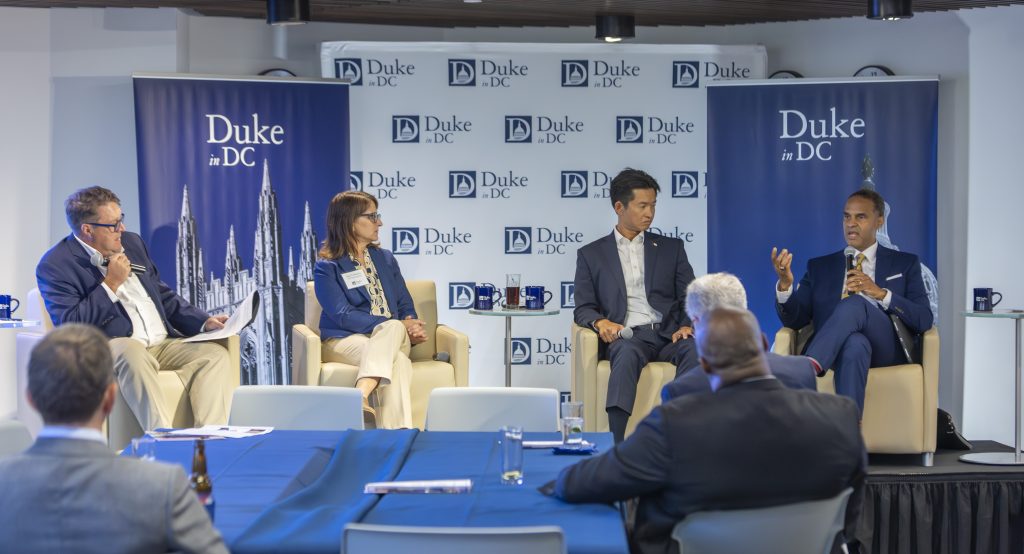
The panel discussion, moderated by Duke University’s Vice President for Government Relations Chris Simmons, featured comments from Provost Alec Gallimore, Chris Chung from the Economic Development Partnership of North Carolina and Sara Lawrence, Director, Economic Development, RTI International.
NC in DC: Bolstering Global Competitiveness through a Research-Based Economy panel discussion at the Duke in DC office. Speakers include Chris Chung, Chief Executive Officer, Economic Development Partnership of North Carolina; Alec Gallimore, Provost and Chief Academic Officer, Duke University; and Sara Lawrence, Director, Economic Development, RTI International; moderated by Chris Simmons, Vice President for Government Relations, Duke University (Jared Lazarus)
As a world leader in biotechnology, national security, agriculture, healthcare, energy, and more, North Carolina’s strategic research collaborations propel it to the forefront of the global economy.
North Carolina currently ranks among the top 25 economies in the world. Recent data highlights that Duke University alone spends more than $1 billion annually with over 4,000 North Carolina-based vendors and contractors. In FY22, Duke ranked 9th in the nation for total research and development expenditures, surpassing $1.39 billion.
The focus of the panel and dinner discussion was to underscore for federal policymakers the crucial role of industry-academia partnerships in maintaining North Carolina’s research economy. The discussion also highlighted the need for state and federal support to reinforce these efforts.
NC in DC: Bolstering Global Competitiveness through a Research-Based Economy panel discussion at the Duke in DC office. Speakers include Chris Chung, Chief Executive Officer, Economic Development Partnership of North Carolina; Alec Gallimore, Provost and Chief Academic Officer, Duke University; and Sara Lawrence, Director, Economic Development, RTI International; moderated by Chris Simmons, Vice President for Government Relations, Duke University (Jared Lazarus)
The conversation explored why industries, ranging from electric vehicle manufacturers to life sciences leaders and more, new expansion opportunities in North Carolina., one expert Given the number of higher education institutions across the state, the panel agreed North Carolina is well-positioned to says it comes down to the abilityallow employers to find a qualified , upskill and retain a workforce, what policymakers can do to help those processes, the answer includes removing the barriers to the workforce, such as: access to childcare and trainings that might help employees succeed.
The panel also discussed how investing in talent impacts not only the large metro areas of North Carolina, but also extends into the most rural communities. North Carolina provides numerous opportunities to examine similar communities and their successes and implement successful economic models across the state. The panel of experts reinforced the need to share research, data and talent to help make North Carolina the next industry hotspot.
NC in DC: Bolstering Global Competitiveness through a Research-Based Economy panel discussion at the Duke in DC office. Speakers include Chris Chung, Chief Executive Officer, Economic Development Partnership of North Carolina; Alec Gallimore, Provost and Chief Academic Officer, Duke University; and Sara Lawrence, Director, Economic Development, RTI International; moderated by Chris Simmons, Vice President for Government Relations, Duke University (Jared Lazarus)
The conclusion of NC in DC highlighted the power of Duke University as a convener as attendees engaged in meaningful conversations and connections extending beyond the panel. Through programs like this, Duke remains a purposeful partner in showcasing that businesses, policymakers, and higher education professionals alike are working together to bolster North Carolina’s global competitiveness through a research-based economy.