The ceiling inside the dome of the U.S. Capitol

Category: Blog Page 10 of 18

On the Hill, Deans Promote Higher Education's Power to Transform Lives

Now in their positions for several months, Deans Judith Kelley of the Sanford School of Public Policy and Toddi Steelman of the Nicholas School of the Environment visited Washington, D.C., Nov. 27 and 29 to share their visions for the future of environmental science and public policy with policymakers and members of the wider Duke community.

The deans each spent a day speaking with Members of Congress and their staff, journalists, and alumni in conversations meant to further one message: Duke advances society. As Duke looks forward to the next era of scholarship and service, Deans Steelman and Kelley urged the D.C. community to conceive of the modern university as a means of collective community improvement.

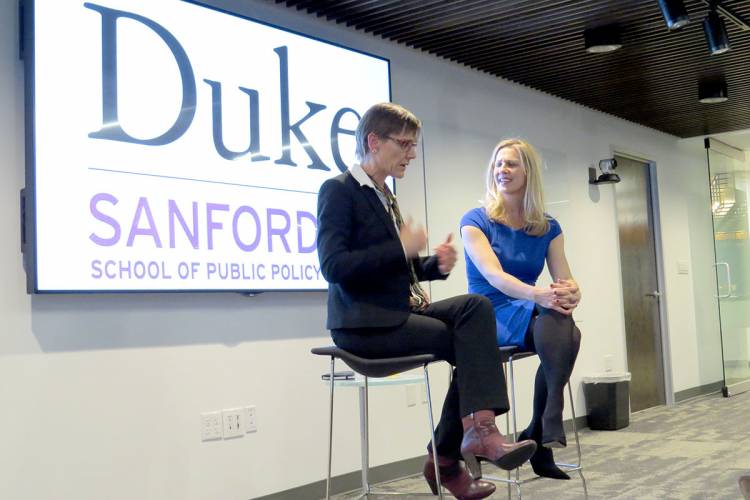
Kelley spoke at an evening alumni event Nov. 27 with Amy Hepburn, Felsman Fellowships Adjunct Faculty at the Sanford School, about Kelley’s personal story and her path to Duke. As an immigrant who received financial aid to attend a California community college, Kelley spoke to the ability of college and graduate education to be a transformative experience – both in one’s perspective on life and one’s professional opportunities.

Sanford Dean Judith Kelley, in conversation with Amy Hepburn, discusses her vision for the school during a session with Duke alumni. Photo by Colin Colter

Steelman spent much of her day Nov. 29 on Capitol Hill meeting congressional representatives and their staff to discuss the role of environmental science in policy-making. Steelman emphasized the importance of sustainable jobs and how she is more than “just an environmentalist.”

As a compliment to that idea, she shared how the Duke Marine Lab is now fully recovered from its Hurricane Florence damage.

“The value [of the Duke Marine Lab] is threefold” said Steelman in an end-of-day interview with Duke in DC staff. “We are good neighbors who volunteer in the community, as we have with our efforts with the Boys and Girls Clubs in the region; we demonstrate and practice resilient co-existence in how to live in this complex land and sea-scape; and we are doing cutting-edge research to learn about our changing biophysical and social environments during a time of changing climate.”

Steelman also shared that image of sustainable, environmentally responsible coexistence with a roomful of university alumni later that evening Nov. 29 when the Duke Alumni Association regional office hosted her for an event. The conversation focused on the importance of retaining environmental determinants in current policy-making.

Cadets on Campus: The Life of an ROTC Student at Duke


by Amy Kramer, T’18

There’s something special about the bond you forge with your peers while doing pushups in the rain at 5:50 a.m. It’s akin to walking through the Pentagon and being stopped by every Duke alum wanting to reminisce about how great it is to be a Blue Devil. We’re proud to be at Duke, a campus that embraces the military and provides plenty of opportunities for professional growth within the national security space.

Cadet Life

On Thursday afternoons, amidst a sea of Duke blue, it is not hard to spot some camouflage passing in front of the chapel on Abele Quad. In uniform only on the days when ROTC labs are scheduled, Duke ROTC Cadets balance one desert-sand-colored boot in the military world, and one Birkenstock in the civilian one. Putting down rubber M4 rifles and picking up musical instruments, or swapping camo for brightly-colored dance team uniforms, cadets transition with ease and become more committed civic leaders in all their ventures across campus.

Opportunities for ROTC Cadets vary by department. Army Cadets each year participate in field training exercises at Camp Butner and Fort Bragg, attend a staff ride, and visit Washington D.C. to learn about military and national security policy. Air Force Cadets can participate in professional development training, national defense education and community service through the Arnold Air Society Program. Navy Cadets shadow enlisted sailors and junior officers on ships, subs or aviation squadrons. Navy Cadets also participate in a Capitol Leadership Conference each fall, through which they engage with Navy leaders in D.C.

All cadets can earn scholarships, shadow different specialties assigned to a base or pursue advanced critical language study such as Chinese, Arabic or Farsi. Most importantly, ROTC classes are open to all Duke students and no experience is required. If you have an interest in the structure or function of any of the service branches, or want to augment your Trinity College curriculum with a military history or military policy course, you are encouraged to do so.

Civilian Blue Devils

But opportunities for students to engage with military and policy leaders extend far beyond ROTC on-campus programming. Duke’s close proximity to both Fort Bragg and Washington, D.C. means that Cadets and civilians alike have access to military and national security education beyond the classroom.

The Duke Program in American Grand Strategy (AGS) is one example. Duke leveraged distinctive strengths in political science and public policy to create this signature program for students interested in national security policymaking. The mission is to raise the next generation of leaders by studying current strategists and scholars. Through the AGS program, students have access to advanced seminars, a distinguished speaker series, research and publication opportunities, summer fellowships and experiential education trips.

Duke is one of a few civilian institutions in the country that hosts annual staff rides – military history trips first conducted by the Prussians in the wake of the Napoleonic Wars. Blue Devils continue the tradition by adopting historic roles and studying past battles more deeply and intimately than is possible in a traditional classroom lecture. By studying past leaders, students understand not just the events that transpired, but the reasons why decisions were made. Students learn empathy and the value of varying perspectives in understanding past events and how they fit into the broader geopolitical context.
Recent staff rides hosted by the American Grand Strategy Program have included Normandy (WW2), Grenada (1983 Operation Urgent Fury), Vietnam (1968 Tet Offensive) and most recently WW1 (Hundred Days Offensive).

Many of these national security education programs are specifically oriented towards civilians in order to increase familiarity and understanding of the military, even though many Cadets also participate. For example, each year, civilians visit a Navy SEALs base and the Special Forces Operations Center at Fort Bragg. Duke is also one of the only universities to host War College Fellows through the Counterterrorism and Public Policy Fellowship Program. These advanced military officers, usually Lieutenant Colonels and Colonels, spend a year on campus taking classes with students. Building relationships with these distinguished military officers is one of the best ways for Duke students to engage with the military.

National security studies would be incomplete without courses in intelligence. The Triangle Institute of Security Studies combines the strengths of Duke University, UNC Chapel Hill, North Carolina State University and North Carolina Central University. Through this collaborative program, students may pursue a certificate in national intelligence, travel to Oak Ridge National Laboratory, tour various national intelligence agencies, participate in the Annual Colloquium and Simulation and present senior theses to national security scholars. This four-year program thrives on cross-campus engagement and aims to contribute towards a more informed citizenry.

From Policy to Practice

Understanding that the future of national security requires more than just a background in political science, Duke tech-oriented students are encouraged to join the Duke Cyber Team. Sponsored by AGS and coached by an executive from the NSA, the Duke Cyber Team studies emerging cyber threats through weekly expert briefings from experts in industry, intelligence and academia. It also educates the Duke community on cutting-edge cyber issues and participates in the national Atlantic Council Cyber 9/12 Competition, competing and networking with cyber professionals in DC each year. Additionally, the Duke Center on Law, Ethics, and National Security at the Duke Law School hosts the LENS Conference, attracting military and national security leaders to campus to engage with students on the complexity of cyber security and cyber operations.

One of the most public and well-received national security events on campus in recent years was the “Crisis Near Fiery Cross Reef” Winter Forum. In this comprehensive three-day South China Sea crisis simulation, Duke undergrads made high-stakes decisions in real time in a scenario in which a US Navy ship was attacked, sparking an international crisis. The goal, as articulated by Tim Nichols, one of the Winter Forum directors, was to “expose a broader slice of Duke to the relevant issues and thought processes around national security decision making.” This exposure is only one of the many special facets of the Duke experience for students interested in national security.

Five Questions with Tommy Sowers

Duke University’s growing connection with the military comes through its student body, faculty and staff and can be found in the classroom and in research. With the establishment of a regional office for MD5, the Pentagon’s national security technology accelerator, in Durham this summer and the kickoff of its Hacking for Defense (H4D) program at Duke in Spring 2019, Duke students and faculty have new avenues to work with Defense Department officials to develop their most pressing national security need: innovation.

The Office of Government Relations recently spoke with Tommy Sowers, Southeast Regional Director of MD5 and visiting professor at Duke’s Sanford School of Public Policy. He discussed the Hacking for Defense project and the next generation of American innovation superiority.

1) What is Hacking for Defense?
Hacking for Defense teaches students how to build a startup to solve a national security problem. It is a semester-long graduate-level university course designed to introduce students to the lean launchpad methodology for entrepreneurship and to apply what they learn to real-world national security problems. First introduced at Stanford, the course was co-created by Steve Blank and Peter Newell. It is grounded in the customer development methodology created by Blank and problem-curation techniques Newell devised when he was head of the Army’s Rapid Equipping Force. Student teams form around national security problem statements procured for the course from Department of Defense problem sponsors.

More than 25 universities have adopted the course since it launched in 2016. Teams develop a hypothesis for a solution to the sponsor’s problem and then test their hypothesis in customer interviews. They spend much of the course articulating, testing and refining their hypothesis. The culmination of the course involves presenting the results of the student team’s testing of the solution hypothesis during 100-plus customer interviews. Students learn a systematic approach to practical problem-solving in the context of product/solution development. Department of Defense problem sponsors benefit from the application of new ways of thinking brought to bear from some of our nation’s brightest young minds.

2) What is MD5 and why did the Pentagon decide to open a regional office in Durham?

MD5 is a program office out of the Office of the Secretary of Defense and is an innovation organization whose purpose is to build new communities of innovators to solve urgent problems of national security. We are building a network of problem-solvers from the communities of the Department of Defense, the nation’s top research universities and the venture economy. Our fundamental premise is that technological superiority alone is not an adequate strategy to maintaining our competitive posture and preparedness in the context of the democratization of technology and intellectual property.

We believe that the Department of Defense needs to have access to a persistent problem-solving resource that is characterized by a cognitive diversity and agility not presently available within DOD alone. Our national strategy for building these new communities is prosecuted at the national level via institutional partnerships with major research universities such as MIT, Columbia, CU Boulder, UC Berkeley, Stanford and most lately at Duke.

“Enlisting the ingenuity and fresh perspectives of those in academia is vital to maintaining advantage for those defending our nation.”
— Tommy Sowers

The Triangle area is rich in talent and offers access to one of the nation’s burgeoning entrepreneurial ecosystems alongside world-class public and private research universities. It is also a target-rich environment for building and connecting new communities of innovators. The military is North Carolina’s second largest industry (just behind agriculture), and we have found a very receptive environment amongst the state’s public leadership.

3) What are some of the biggest innovation challenges facing the Pentagon?

The problems facing the Department of Defense are myriad, and have areas of increasing overlap with the innovation challenges faced by commercial enterprise more broadly. Technological innovation in areas such as cybersecurity, artificial intelligence, robotics and advanced logistics have application not only to defense problems but have commercial value as well. This is why we are strong advocates of both dual-use technology strategies (products and solutions that can equally serve commercial and defense markets) and the development of dual-use startup ventures. Startups represent a powerful model for problem-solving that offer speed, agility and the efficient consumption of resources.

However, the most important challenge facing the Department of Defense is its need to reliably and productively connect with non-traditional problem solvers. There was a time when the DOD could sufficiently direct the resources necessary to maintaining a competitive posture with its peers and adversaries. However, both the diffusion of talent into the entrepreneurial sector of the economy and the innovativeness and agility of adversaries unconstrained by rule of law and institutional norms have fundamentally altered the terrain of national security. The most important challenge facing the DOD, therefore, is to build a persistent problem-solving network that can sustainably meet the challenges that are generated by conditions of global uncertainty.

“If we intend to build a strong and sustainable national security innovation base, collaborating with those beyond the ‘walls’ of the DOD isn’t a nice-to-have, it’s a need-to-have.”
— Tommy Sowers

4) Besides H4D, what are ways in which academia can collaborate with and/or support the mission of MD5?

The other major program through which we engage with universities, their students and faculties, are our hackathons. These are three-day long “collision” events, which are organized around a challenge statement. Recent examples include developing techniques to counter the malicious use of drones and the problems confronted by those who maintain critical infrastructure and must guard against vulnerability to cyber-attacks.

The hackathon events are often staged on university campuses or in partnership with relevant university departments and seek to draw on university student talent. These events also provide opportunity for the university community to engage with innovators in the Department of Defense as well as those from industry and the entrepreneurial sector.

5) What advice would you give Duke students interested in engaging on national security issues, and what advice would you give Pentagon officials interested in engaging universities and university students on national security issues?

We advise Duke students to approach the opportunity to work on national security problems with an open mind. We consistently find that students find not only a sense of challenge in these collaboration opportunities, but also a sense of purpose in solving problems that can have lifesaving importance.

To those in DOD, we suggest that enlisting the ingenuity and fresh perspectives of those in academia is vital to maintaining advantage for those defending our nation. If we intend to build a strong and sustainable national security innovation base, collaborating with those beyond the “walls” of the DOD isn’t a nice-to-have, it’s a need-to-have.

Crisis at the WTO and the Future of Trade Dispute Resolution

The future of international trade rests on the future of trade dispute resolution, argued the Jeffrey and Bettysue Hughes Professor of Law Rachel Brewster, Ph.D. yesterday, Oct. 18 at a congressional briefing on Capitol Hill. In detailing the World Trade Organization’s dispute settlement structure, Brewster honed in on the mechanism American trade policy specialists once cared about more than any other: the Appellate Body.

To a room full of congressional staff whose work involves trade issues, Brewster laid out the growing crisis of the WTO. The seven-member Appellate Body is down to thee current members (sometimes casually referred to as ‘judges’) and the United States is blocking the appointment or re-appointment of all new members until reforms are made to the body. However, the United States has yet to lay out the specifics of those demands.

By Dec. 2019, the Appellate body will be unable to hear any cases and will halt all international trade dispute hearings.

Brewster detailed the current debate around WTO appellate body structure. Some policymakers within the Trump administration have mentioned discomfort with the WTO’s Rule 15, or how the Appellate Body makes decisions along a timeline. They have also mentioned concern that the Appellate Body is deciding issues of law that are not strictly necessary to resolving cases at hand.

Some experts outside the administration argue that stonewalling the renewal of the Appellate Body is part of a greater strategy to move away from transparent, rules-based trade practices in favor of using market power to settle trade disputes.

The United States is the country that first wanted a trade dispute settlement body. This WTO pseudo-court, argued Brewster, gives legitimacy to American international trade law and allows for a clear, accessible rules-based international system that mirrors many aspects of U.S. appellate court practice. The original Uruguay Round treaty of 1995 that created the WTO also allowed for transparent, timely and decisive ends to trade disputes that would otherwise drag on indefinitely, argued Brewster.

Without the WTO’s Appellate Body, international trade disputes would return to the pre-1995 General Agreement on Tariffs and Trade (GATT) status quo. Previously, states bounced differing interpretations of international trade law back and forth – sometimes for years –in the hopes of negotiating a resolution.

A dysfunctional WTO also creates uncertainty for businesses trying to navigate international landscapes and might enable other countries to act against free market interests. Arguments in favor of keeping some form of the Appellate Body focus not just on the fact that the United States wins a majority of cases it brings (87%), but also on the implications of writing transparent rules for how countries interact with each other.

The Defense Innovation Board and the Ethics of A.I.

Current debates around artificial intelligence promise much but define little. This past Wednesday, Oct. 10, the Defense Innovation Board held an open hearing on the best, most ethical way to incorporate AI into the battle space and into Department of Defense daily operations. One idea kept resurfacing: the meaning of intelligence.
Having committed to the recently vogue world of machine learning, the Department of Defense faces a daunting task optimizing, accessing and streamlining millions of users and apps and thousands of software systems, many of them mission critical.

Duke University Professor in the Department of Mechanical Engineering and Materials Science Mary “Missy” Cummings recently joined the board and quickly offered suggestions on the best way to frame machine learning systems.

Drawing from her research on autonomous systems, she spoke about the fallacy in thinking that computers lack human bias. Humans must code the system, select data, select testing facilities, select participants and much else. Humans design the entire world in which one builds an autonomous system.

But the DoD should take more from this example. It is not enough to say that machines carry their creator’s bias. Cummings rightly posited that patterns in a code or statistic do not themselves own objective truth.

The most important part of any machine learning system will still be the human interacting with it. The next generation warfighter will not just face kinetic threats on the battlefield, but also the heuristics of a machine meant to help them.

Congress Faces a Long To-Do List this Legislative Season

JIM BOURG / POOL / GETTY IMAGES

JIM BOURG / POOL / GETTY IMAGES

September 6, 2018

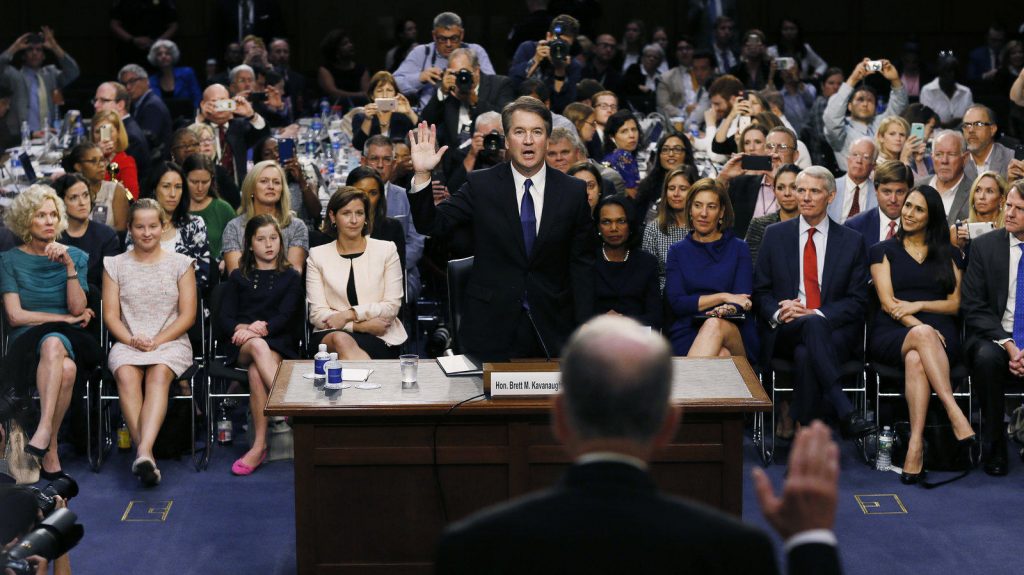
Although on campus September begins the new year, it is the last month for Congress to accomplish anything before midterm elections. This past year saw a massive topline budget deal struck between the two parties, short-term government shutdown this spring and various court cases pertaining to immigration. Fall 2018 shows no signs of slowing down. With the midterm elections in November, continued immigration litigation, a threatened government shutdown and, of course, confirmation hearings for Supreme Court nominee, Judge Brett Kavanaugh Congress faces a long to-do list this legislative season.

Appropriations

In August, the Senate passed an $857 billion FY19 minibus-spending package that funds the departments of Defense, Labor, Health and Human Services, and Education. Before leaving for the month-long August recess, the House passed six of their 12 appropriations bills; the Senate passed nine. To hash out differences, the House and Senate began a conference meeting this week for the FY19 minibus-spending package that funds Energy, Nuclear Security, Veterans’ Affairs and Congressional operations. Initial negotiations are also underway for the package that contains the Defense and Labor, Health and Human Services, and Education bills. No spending bills have made it to President Trump’s desk for signature.

The Association of American Universities (AAU) has a chart illustrating the current state of appropriations, both in terms of funding levels and legislative progress. The prospects for federal research and education programs are positive as both House and Senate bills include increased funding above the Administration’s request.

Two salient examples can be found in NEH and ARPA-E, both of which the administration’s budget request proposed for elimination. The House not only funded both, and in the case of NEH, at a record high level, but also defeated attempts to defund the programs during floor consideration. Every Republican Member of the North Carolina delegation voted in favor of amendments to defund those two programs. Despite the momentum this spring and summer for developing bills that contain positive funding recommendations, Congress faces a deadline to pass the final compromise funding packages or a continuing resolution to fund the government by the end of this month. President Trump suggested he might shut down the government in order to secure funding for his border wall, but Republicans on the Hill have yet to echo that interest.

Congress also spotlighted alleged academic espionage at universities through hearings and various legislative proposals this summer. Most prominent was the so-called Gallagher amendment to the National Defense Authorization Act, which attempted to limit funding to researchers participating in foreign talent recruitment programs. Thanks to efforts from the higher education community, that amendment was replaced with language in the final National Defense Authorization Act that creates a forum for universities to engage with DOD and other security agencies to discuss effective ways in which to address issues involving national security.

The Higher Education Act

The House GOP’s rewrite of the Higher Education Act, dubbed the PROSPER Act has hit a legislative wall. Chairwoman Virginia Foxx (R-NC) pushed her bill through committee last fall in the hopes of speeding its passage, but the bill has yet to be called for consideration on the House floor due to lack of support amongst Republican members. Duke opposes the bill because of its significant changes to federal student loan programs that would drastically limit access to higher education, particularly for graduate and professional students.

Stuck in the Courts

The only part of government moving slower than Congress is the courts with net neutrality and the DACA program still in legal limbo.

Net Neutrality

In December 2017 Republican FCC Commissioner Ajit Pai ended the 2015 net neutrality rule that ordered internet service providers treat all content flowing through their cables and cell towers equally. In May 2018, the Senate voted in favor of a bill to overturn the FCC decision through the Congressional Review Act, but the House has yet to act on the measure. The FCC ruling went into effect this past June, but is being contested in the courts. AAU recently authored an amicus brief supporting net neutrality for one of the cases.

Deferred Action for Childhood Arrivals

So far, six federal courts have heard DACA-related cases with two decisions ordering the government to keep the program going despite proposals to end it earlier this year. Friday, Aug. 17, D.C.-based District Judge John Bates walked back his demand that the Trump administration accept new DACA applications. However, this order does not interfere with previous decisions that the Trump administration continue processing existing DACA renewals.

In a suit filed by Texas and six other conservative states, a federal judge declined to order the government to end the DACA program citing the states’ inability to prove that the DACA program caused them “irreparable harm.” The judge questioned the legality of DACA but argued that DACA recipients would face more harm if they lost the program.

This ruling means the Trump administration must resume accepting renewals for the existing 700,000 DACA recipients, perhaps until June 2019 when the Supreme Court may weigh in.

Duke supports the right of DACA students and colleagues to stay in the United States and to continue their studies and contribute to our communities and the economy.

National Security

Another area of immigration under additional scrutiny is Congressional concern with international student and researcher roles in alleged breaches of national security and the loss of intellectual property. In light of these concerns, additional vetting of visa applicants is likely in the coming months.

National Quantum Initiative

Congress worked through the summer to bring the National Quantum Initiative into existence. The administration also elevated quantum information sciences to priority status through their inclusion in the FY 2020 R&D budget priorities memo sent to agencies in late July. The National Quantum Initiative Act coordinates a federal program to accelerate quantum research and development for the economic and national security of the United States. Duke has been a key stakeholder in this process and will continue to work closely with peer institutions as this proposal moves through Congress.

Fall 2018

Fall 2018 proves to be a challenging season for Congress. As they veer towards a fiscal dead-end and avoid overly distracting issues before the midterm elections, the Duke Office of Government Relations will continue to keep you updated on important legislative matters.
For more regular updates sign-up for our twice-weekly newsletter detailing important federal policy updates and follow us on Twitter @DukeinDC.

Political Science and the Science of Politics: A Crash Course in U.S. Policymaking


Summer is intern season in Washington, D.C. Young people from across the country journey to the capital to work, network and expand their professional acumen. For the DukeEngage Science & Society program, summer is also a time to explore the boundaries between policy and the scientific process.

DukeEngage Washington, D.C. takes students with experience in science and public policy and places them in internships where they confront the importance of connections between those two, often disparate, fields.

Originally focused solely on health policy, the DukeEngage Science & Society summer internship program now highlights many arenas of federal science policy. One student used his computer science coursework from Duke to the help the National Institutes of Standards and Technology (NIST) study the impacts of quantum computing. Another student used her political science research skills to help the Niskanen Center better confront climate change skepticism and to shape public debate.

Program Director Thomas Williams, said the students’ work “experience is augmented through community engagement, group discussions, a speaker series and an array of enrichment activities that provide them with the skills and experiences to consider the many facets of policymaking, especially as it relates to the use of science in the process.”

DukeEngage Science & Society breaks students out of siloed academic pursuits and challenges their classroom work with real world problems.

In addition to opening the program to different science policy fields, Williams has added in a speaker series for students to directly address experts. Students this summer discussed drug pricing with a pharmaceutical lobbyist and debated climate change with a former lawmaker – all in the name of asking difficult questions of those in power.

Closer to the students’ D.C. home, Williams encourages discussion of gentrification and urban development. Sometimes, local level government more clearly shows the ramifications of science in policymaking than one can see at the federal level.

As Washington, D.C. grapples with a growing population, and income and quality of life disparities around the city, the program hopes to open students to difficult conversations on urban design, public transportation, clean water and even what items a city should recycle. In order for the DukeEngage Science & Society program to engender a sense of policy as service, Williams and program staff use city-level issues to put in context the difficulty of deriving scientific direction and policy solutions.

Connecting dots for the students is only half the program’s mandate. Connecting dots for policymakers is the other half. According to Williams, one of the easiest ways to convey scientific information with policymakers comes from “embracing narrative in addition to science – placing value in storytelling makes science approachable and relevant in everyday life.” As policymakers confront a deluge of information each day, the information best presented to them will last. Politicians love a good story.

Williams pursued his masters in bioethics while finishing his law degree at the University of Pennsylvania. He knows well the balance between communication, deliberation and the scientific process. That background in diverse fields helps redirect the DukeEngage D.C. program toward a more holistic understanding of science in policy.

All DukeEngage programs hope to build a sense of civic responsibility in students through community service and volunteering. But the Science & Society Program shows students the potential benefits of a career serving the public interest. Although limited to three months, the program leaves students with skills and perspectives to serve them a lifetime. With an appreciation for the complexity and importance of getting science policy right, a DukeEngage D.C. experience far outlasts the summer intern season.

Making Young Voters Through Institutional Reform


When compared to older generations, young people don’t vote in quantities representative of their population. Despite being roughly equivalent percentages of the voting-age public, 18-29 year-olds vote at half the rate of those 60 years plus. Conventional wisdom argues young people are lazy, apathetic or lack ‘civic virtue.’ One Duke research project wants to push back on that narrative in order to understand how politically motivated young people fail to engage, despite wanting to vote.

In line with the Duke Bass Connections program mission, knowledge works best when it serves a local community. In order to evaluate why young people do not vote in levels comparable to their older peers, Duke University’s Bass Connections program wants to examine the institutional and motivational issues stanching turnout in North Carolina.

With a grant from the National Science Foundation, Duke Professor of Political Science and Public Policy and Director of the Duke Initiative on Survey Methodology D. Sunshine Hillygus, Ph.D. leads students (both undergraduate and graduate) on the Bass Connections project Making Young Voters: Policy Reforms to Increase Youth Turnout that lasts from summer 2018 to spring 2019.

With so much university coursework focused on research at a distance, this project puts undergrads to work on an active federal grant. Bass Connections programs teach students the minutiae of fieldwork as they tease through the problems of amassing data. From collecting survey results and working with school administrators to interviewing subjects and culling through state legislative records, the Making Young Voters project hopes politically activate young people as well as research-oriented young scholars.

By leveraging longitudinal modeling and survey data, the project team hopes to understand what keeps young people from the polls. Their data will consist of school administrative records, voter registration files, student surveys and tests on the effects of mobilization efforts all collected from Wake County high schools.

According to Professor Hillygus, “this [youth voting issue] is such an important topic not just because normatively it is worth increasing turnout among young people, but it [also] directly shapes who is elected and the policies that get passed.” She continued, “if there is any wonder why social security is considered the 3rd rail of politics while education spending is being gutted, just look at the turnout rate by age.”

A component of that main question is what elements of the voting policy environment help or hinder young engagement. The Bass Connections team will also do a landscape analysis of a broad set of policy reforms in order to develop a framework to understand why some efforts work and others do not. There is no dearth of efforts to mobilize youth voting, but there is a shortage of comprehensive analyses of those efforts. This Bass Connections project hopes to fill that gap.

In addition to their actual survey results, the project hopes to compile various reports, a conference presentation and a comprehensive archived database on North Carolina electoral and educational policies.

Another component of the project studies civic education. Most civic education classes in high school focus on test-taking and fact memorization. Recent studies suggest that the most successful (in terms of youth vote mobilization) civic education efforts emphasize noncognitive skills: “the general abilities associated with self-regulation and social integration that are not captured by standard measures of cognitive proficiency,” according to the project website. Perhaps the most important noncognitive skill relevant to political activity throughout one’s lifetime is the ability to follow through on goals.

The Bass Connections team hopes to address the psychosocial skills needed to make that participation leap: how to work with others, plan for long-term goals and think about voting barriers (taking time off from work, registering on time, finding a polling station, what to do if one’s registration stalls, etc.).

As Hillygus noted, the ability to pursue future objectives is a better predictor of long-term voting patterns than are political interest, cognitive ability, parental involvement and socioeconomic status.

What makes people responsible citizens is not necessarily subject matter knowledge. “It turns out that civic educators might need to focus less on getting students to memorize the names of Supreme Court Justices and instead to teach them how to fill out a voter registration reform correctly or what to do if they show up to vote and find their name is not on the voter rolls” argued Hillygus.
—–
This post is part of our Duke in North Carolina Series showcasing Duke’s activities in and in service to local communities, environments, economies and people.
See more here.

Price Visits DC to Meet with Students, Policymakers

In an effort to build long-term relationships and reiterate the university’s commitment to openness, access and intellectual rigor, President Vincent E. Price spent July 10 and 11 in Washington, D.C., to meet with students, alumni, journalists and members of Congress to share Duke’s perspective.

Price spent his first day in D.C. meeting with U.S. Senators Richard Burr (R-NC), Thom Tillis (R-NC) and Shelley Moore Capito (R-WV) T’75.

In the evening, he dined with Duke Engage Science and Society students. The conversation ranged from the students’ internships and the lifestyle of Washington, D.C., to the Duke housing policy and free speech on campus. Led by Eric Mlyn and Thomas Williams, the Science and Society program has students study several of the most difficult health, technological and environmental policy problems of the day.

Over dinner, Price talks with Duke Engage students in DC about their work and issues affecting higher education. Photo by Chris Simmons

Over dinner, Price talks with Duke Engage students in DC about their work and issues affecting higher education. Photo by Chris Simmons

The following day, Price brought Duke’s concerns and aspirations to a larger audience. He spent his morning speaking with journalists about the importance of Duke as a policy-forward institution, one that prizes openness and access. Price then spent the afternoon meeting members of the House of Representatives. After lunch with Congressman Bradley Byrne (R-AL) T’77, he met with Scott Peters (D-CA) T’80, G.K. Butterfield (D-NC), Virginia Foxx (R-NC) and Richard Hudson (R-NC).

US Rep. Scott Peters, a Duke alumnus, discusses issues with President Price.

US Rep. Scott Peters, a Duke alumnus, discusses issues with President Price.

Price then hosted the annual Sanford on the Hill event at the Capitol Visitor’s Center with Judy Woodruff T’68 and Representative David Price (D-NC). Sanford on the Hill offers alumni in politics on and off Capitol Hill the chance to meet and share their experiences in the policy world. (Read more about the event here.)

One idea drove the entire trip. “A research university is dedicated, not just to transmitting knowledge, teaching, but to discovery, advancing knowledge, pushing the boundaries of knowledge,” said Price, who is a leading global expert on public opinion and political communication. “And policy-making is at its best the application of that knowledge to support the collective welfare. If we want our research, our discovery at Duke to make a difference, a primary vehicle for that is through the public policy process.”

Opening Doors to College


As a leader in higher education, some of North Carolina’s most valuable resources are its college students. Five years ago, Duke University started a chapter of the College Advising Corps, which offers an opportunity for young graduates to give back to local North Carolina communities using one of the skills they know best: how to get in to college.

The College Advising Corps aims to raise the rates of college enrollment among low income, first generation and minority high school students. The Duke College Advising Corps places near-peer advisers in 16 central North Carolina high schools where they teach students about the college admissions process, financial aid opportunities, test preparation and career opportunities. Within North Carolina, UNC, Davidson and NC State also host chapters of the national College Advising Corps, which is based in Chapel Hill, North Carolina.

The Duke College Advising Corps receives support from The Duke Endowment, the Belk Foundation, AmeriCorps and is a joint initiative with the Assistant Vice Provost of Civic Engagement. College Advising Corps recruits recent Duke graduates to fill the role of college adviser. Upon selection, they undergo a four-week training course to refresh their college access knowledge and to learn more about the high school landscape in North Carolina.

Near-peer advisers are better able to communicate with young adults and to share their more recent experiences in college. For example, many of the advisers attended Duke with the help of Pell grants and were first-generation college students themselves, like many of the students they advise. Given this recent and similar experience, advisers offer a window to possibilities high school students might otherwise not be able to see.

Impact on the High School Students

Early data suggests that College Advising Corps significantly increases the number of students open to pursuing a college education. After engagement with an adviser, students are more likely to say they are aware of college affordability opportunities, that they are more knowledgeable of the application process and have career goals that include a college education.

The Duke College Advising Corps serves 16 high schools across four Congressional districts serving a total of 14,815 high school students. Since its establishment at Bartlett Yancey High School in Yanceyville, exit data showed marked increases in the number of students who applied to at least one college (74%), visited a college (67%), or spoke with an adviser (84%).

The students at these high schools are ones who otherwise wouldn’t receive top college access coaching. They are roughly 35% African-American, 27% Hispanic/Latino, and 39% white with roughly 58% of them qualifying for free or reduced lunch.

Impact on the Advisers

The experience is also an educational for the advisers. In the one to two years that advisers work for College Advising Corps, they engage directly with students, teachers school administrators and parents. Advisers are more likely to view poverty and social mobility as a relationship between education policy, health policy, drug policy and the criminal justice system.

According to exit surveys, advisers are less likely to see a family’s income as a determining factor in college access. This change is likely due to advisers learning more about the myriad financial aid sources available.
College Advising Corps serves to fulfill Duke’s commitment to public service. Advisers reported having a better understanding of their communities and the structural barriers to social mobility. Advisers begin to view community involvement as “a diversity of ways in which individuals can contribute to their community, both through paid employment and through volunteering.”

A majority of advisers say their participation in College Advising Corps influenced them to pursue careers in public service and to be more involved in their own communities. They reported in their exit surveys being more interested in careers in education, nonprofit work, social enterprise and political advocacy than they were at the start of their service.

More than simply influencing career trajectories, College Advising Corps advisers are more likely to stay in North Carolina after the end of their service. A majority of advisers explain in their exit surveys how much they value the sense of community they have found in the region.
—–
This post is part of our Duke in North Carolina Series showcasing Duke’s activities in and in service to local communities, environments, economies and people.
See more here.

Page 10 of 18

Powered by WordPress & Theme by Anders Norén