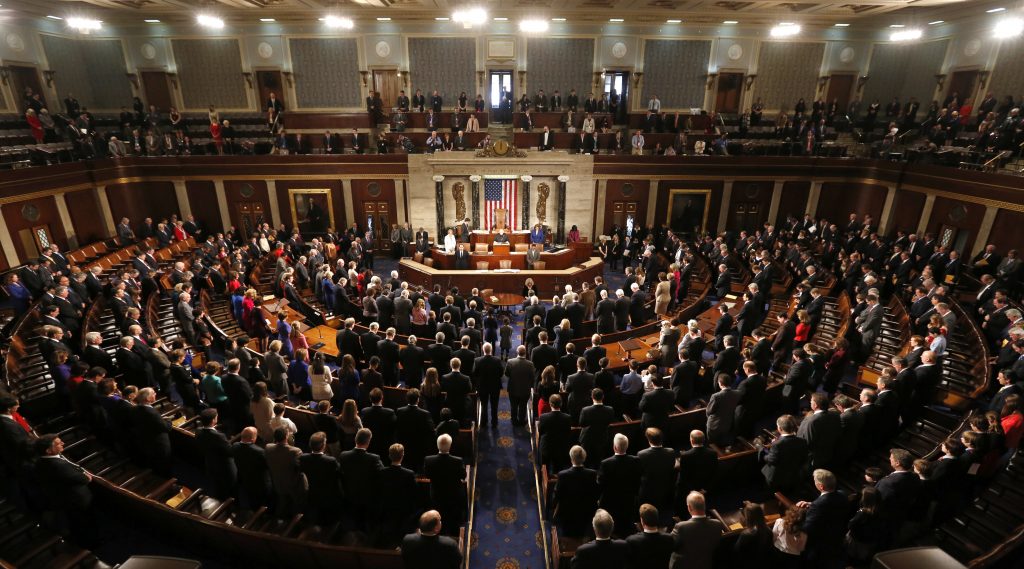
The ceiling inside the dome of the U.S. Capitol

Category: Blog Page 11 of 18

Defense Spending at Duke: So Much More than Meets the Eye

Efforts to create a trapped-ion quantum computer spun off into a VC-funded partnership called IONQ Inc. Photo: IONQ Inc.

Generals may fight the last war, but researchers fight the next. In 2017, Duke performed close to $60 million dollars in research sponsored by the Department of Defense and Defense-related agencies to investigate the future of conflict and the avenues those conflicts may take. Although military objectives fund projects, research done at Duke has myriad implications. From quantum computers to “invisibility cloaks,” only means and imagination limit the future. As a locus of America’s research infrastructure, Duke negotiates that future every day.

According to Vice Provost of Research Lawrence Carin, “Duke has long been a leader in performing research of importance to national security, and that fundamental research has often translated to breakthroughs and technology that extends beyond defense.” However, defense-related work is not just an essential element of Duke’s research portfolio, but is also vital to the US and global economies.

In an effort to lead the world’s technological development, the Intelligence Advanced Research Projects Agency (IARPA) awarded a five-year, $31.9 million grant to a Duke/Maryland/Georgia Tech partnership dubbed Error-corrected Universal Reconfigurable Ion-trap Quantum Archetype or EURIQA. Led by Jungsang Kim, Professor in the Department of Electrical and Computer Engineering at Duke University, this major multi-year award funds the nation’s quantum computing experts.

Contrary to standard computers, a quantum computer allows data to exist in multiple states at a time, thus multiplying its computational potential. Traditional computers represent data in ‘1’s or ‘0’s, on or off. Because an atom’s quantum spin can point in an infinite number of directions, a quantum computer can theoretically represent data in an infinite number of varieties.

Kim’s work on quantum computers uses individually trapped atoms where the internal states of those atoms represent different information. The basics are all in place. The trapped ion “switches” operate. They simply need to be arranged in a complex enough manner that allows both computation and error-correction.

The difference in representational state is as different from current binary code as an abacus is to a MacBook. Whichever group pioneers and standardizes the technology will lead the next century of innovation, invention and large-scale data analysis.

As difficult as it may be to conceptualize the technological impact of a quantum computer, at least one can see it. David Smith, Augustine Scholar and Professor of Electrical and Computer Engineering at Duke, works on something more transparent.

Using a “cloak” made of metamaterials precisely arranged in concentric circles around an object, Smith and his lab have made an object ‘invisible’ to microwaves. Metamaterials are artificial composites that interact with electromagnetic waves in ways that natural materials cannot.

In the frontiers of science, conceptual boundaries break down. Technically, the cloak has neither a reflection nor a shadow. Taking advantage of microwave properties, the metamaterial designed by Smith and his lab bends microwaves around an object and restores them to their original form as if they had passed through empty space. Although metamaterials that can manipulate the visible light spectrum are still speculation, Smith and his lab have already set the stone for microwave “invisibility.”

Not limited to his “cloaking” device, a variety of US government agencies have funded Smith’s plasmonics work over the years: from the Army Research Office and the Air Force Office of Scientific Research to the Office of Naval Research. His work stretches from acoustic metamaterials and 3-D printing to transformation optics and wireless power transfer. With the gains made in microwave “invisibility,” his most famous work is also his brightest.

In cases where one cannot avoid the enemy, force may be required. When extraordinary measures need to be taken, Sheila Patek, Associate Professor in the Department of Biology at Duke, knows extraordinary power.

Her work uncovers the secret strength of mantis shrimp. Peacock mantis shrimp use a hammer-like appendage to smash open snail shells for food. Her lab did high speed imaging on the hammer movement to reveal that peacock mantis shrimp can reach maximum speeds of 12-23 m/s.

However, the remarkable feat is not just the speed. Because the shrimp’s hammer moves so fast, the water cavitates (vaporizes) when the limb strikes the prey. Cavitation is a destructive phenomenon. Wen these vapor bubbles collapse, they cause a small implosion in the water which produces heat, light and sound. The mantis shrimp’s biology allows it to essentially create an explosion under water generating tremendous force disproportionate to its size.

Her work is funded in part by the Army Research Office’s Multidisciplinary University Research Initiative (ARO-MURI) grant program that supports research teams whose efforts intersect more than one traditional science and engineering discipline.

Her experimental insights help expand the possibilities of both bio-mimicry and underwater kinetic engagement. As traditional large submarines find themselves easier to track and slower to reach conflict areas, small-scale underwater autonomous systems will fill the void. Those smaller systems will require unique kinetic systems that can wreak destruction disproportionate to their size, just like the Mantis Shrimp.

But the lines from research to product and invention to innovation are difficult to follow sometimes. Vice Provost Carin offered Professor Richard Fair’s work as an example. “[Richards] performed research for DARPA on microfluidics devices. That technology was translated to a startup, founded by the PhD students supported by DARPA. The company, Advanced Liquid Logic, was acquired several years ago by the gene-sequencing company Illumina, which was developed under DOD fundamental research, and is today being used every day to impact gene analysis and testing around the world. The technology is advancing the health of US soldiers, and everyone else.”

As with much great research, paradigm-breaking discoveries trickle down from government needs to consumer wants. The quantum computer of today may be the hand-held device of tomorrow. What once weighed 40 pounds may one day weigh two. Great research is not simply about making things that didn’t exist before. Great research applies imagination. The long-term results of defense-related funding at Duke will defend the warfighter and advance the nation’s strategic interests, but they will also further technological progress one ion at a time.

Clear and Fair Visa Policies

American prosperity deserves the brightest individuals supported by a fair visa system that encourages them to contribute to the country.

We want the best minds working on such grand challenges as cures for cancer and developing quantum computers. Having the world’s most talented people here in the United States not only makes economic sense, it also allows America to lead human progress on the global stage, scarcely is that leadership more true than in North Carolina. 

Our Dean of Duke’s Pratt School of Engineering Ravi Bellamkonda first came to the United States on a student visa to complete his PhD in biomaterials and medical science and then stayed in the country on a research visa. Now, as the Dean of Engineering, he leads a cancer research lab and designs the next generation of STEM education. 

Immigration Debate and Visas at Duke

Duke is deeply vested in the outcome of the immigration debate beginning this week in Congress. Not limited to our support for a positive outcome for DACA recipients, Duke is a global university committed to bringing outstanding students, researchers and teachers to our campus and the state of North Carolina where they make a difference each day and make significant contributions to our community and economy.

With students from over 115 different countries, Duke has more students on visas from more countries than the total countries represented at the current Winter Olympics. Duke has over 4,500 total individuals working, researching and studying thanks to various visa programs.

Whether from Indiana or India, South Carolina or South Africa, Duke is built on the belief that every member of our community deserves to have the same experiences and opportunities to learn and contribute, no matter where they are from.

Standing Up for DACA

Although the DACA program is planned to expire March 5, each continuing resolution and round of immigration negotiations adds to the climate of uncertainty. Duke University continues to stand for a permanent solution that provides DACA recipients a clear path forward as they plan their lives and continue to be valued members of our community.

Colleges and universities have seen these remarkable people up close in our classrooms and as our colleagues and friends. Despite the challenges they face, they have made incredible contributions to our country, its economy and security, with about 900 recipients serving in the military. In part because of their legal status, many DACA recipients were able to enroll in an institution of higher learning.

Image Credit: ACE, 2018

If we are unable to protect these DACA recipients, we will be shutting the door to a significant group of individuals who represent the best of what being in this country can mean for human achievement.

Terminating DACA would have adverse impacts not only on those recipients and their immediate communities, but the whole of America’s economy. Specific to North Carolina, ending DACA would lead to an estimated GDP loss of $1.2 billion and, by some estimates, up to a $10 billion total cost to the state.

 Image Credit: ACE, 2018

Duke, in collaboration with our peer institutions, is urging Congress to pass legislation as soon as possible that will include protections currently provided under DACA and allow these individuals to continue contributing to our society and economy by working, serving in the military or attending college.

Children brought to the United States at a young age did not have a choice in the matter and are Americans in every way but immigration status. It remains in America’s best interest to enable them to use their knowledge, skills and energy to continue to make the strongest possible contribution to our country.

By highlighting these individuals, the DACA program gave them a chance to engage with the world. They spoke out, they worked hard, paid taxes, application fees, health insurance and now many of these young people are in college trying to improve themselves and the world around them.

Protecting DACA recipients is not simply an economic issue. It is a moral one. It is about protecting young people who embody what it means to be American: self-improvement despite adversity. America asked undocumented students to stand up and gain legal status. Now, it is time to stand with them.

Education, Empowerment Prove Effective in Reducing Exposure to Toxins

Governments are strong, but the consumer is almighty. Scarcely is that better understood than in Duke’s Superfund Research Center (SRC). In addition to advocating for the implementation of safer government policies surrounding toxic chemicals, they engage local North Carolinians to learn about and share options for addressing health risks.

The Superfund Research Center (SRC) at Duke focuses on early, low-dose exposures to toxins and their developmental impacts that are usually only evident later in life. With funding from the National Institutes of Environmental Health Sciences (NIEHS) Duke has conducted Superfund-related research for over 15 years with the goal of identifying and mitigating the effects of harmful toxins on the human body.

In order to properly appreciate the myriad effects of toxic contamination, the Superfund Research Center “promotes an approach to research that is not siloed, but rather multidisciplinary and collaborative, encouraging researchers to focus on real-world problems, which are always multidisciplinary,” said Bryan Luukinen, Sr. Program Coordinator at Duke’s SRC. That multidisciplinary approach led to the creation of a new type of service-research.

The program was renewed in April 2017 with enough additional funding to start the Community Engagement Core. The Core works with communities across North Carolina affected by environmental contaminants, especially insituations related to early-life exposures to chemicals that may have late-life impacts.

Often, communities themselves contact the SRC to request information related to environmental contamination. They engage with people town halls, meetings with mayors and city councils, local lifestyle groups like the North Carolina Gardeners Association or simply by reaching out to fishermen in the hopes of pinpointing public health issues.

The work done at Duke’s SRC “requires that community engagement and research translation are an integral part of the research centers, which facilitates sharing this valuable, taxpayer-supported research with communities in a way that they can understand and is applicable to the local problems they see,” added Luukinen. But SRC work pertains as much to what the consumer can see as to what she can’t.

Flame retardants on and in furniture pose risks to pre-natal health, families and even household pets. Many of these retardants are fat soluble and affect hormones, but the long-term effects on people have only begun to be studied at length.

Duke’s SRC runs a service where people send in samples of polyurethane foam from their furniture and the SRC will test those samples for seven common flame retardants and then provide a fact sheet about risks and options.

ITEHP audience shot

In order to pre-empt risks, researchers at the SRC have also reached out to local pediatricians and OBGYNs to provide them with info about flame retardants. People may not always heed public health warnings as banal-sounding as a furniture hazard but will heed advice given them by a medical professional, especially in times of natal care.

“We are using this funding to build capacity in communities to better deal with things like these in the future. We are trying to build people fluent in the language of environmental health.” said Luukinen, stressing the importance of building long-term relationships that serve communities long after federal funding runs out.

Much of the success behind the SRC lies in their community-based research efforts. A community garden pilot study started last year asks what local gardening practices may affect exposure to contaminants. Through a partnership with the North Carolina Community Garden Partners, SRC researchers study garden management choices: composting, using raised beds, use of fertilizer, cleanliness practices and the presence of children in gardens.

In partnership with an undergraduate computer science class, those researchers then assembled a smartphone app that maps landfills, toxic release inventory sites, brownfields (any land whose redevelopment may be complicated by the presence of hazardous toxins), and residential areas. All these resources existed before but have never been assembled and shared in such an easily accessible medium. Local gardeners will hopefully use this app to make informed decisions about what products they use and where.

According to Catherine Kastleman, a Program Coordinator with the SRC, “we live in a world of complex chemical exposures, and the more we can understand about the mechanisms of toxicity of these substances, especially during early life stages and sensitive windows of human development, the more effectively we can take action to protect public health and the health of our environment.”

From soil-sampling and gymnastics foam and science education and long-term capacity-building, Duke’s Superfund Research Center builds results from the ground up. When it comes to the business of citizen empowerment, SRC researchers get their hands dirty.
—–
This post is part of our Duke in North Carolina Series showcasing Duke’s activities in and in service to local communities, environments, economies and people.
See more here.

What to Expect When You're Legislating

REUTERS/Kevin Lamarque

The best laid schemes of mice and men never met the wrath of the U.S. Congress. With 2018 in full legislative swing, this year promises tight deadlines, fiscal cliffs and legislative brinksmanship. In election years, lawmakers typically avoid writing major legislation, but with the backlog of issues from 2017, the 2018 midterms look to be a spattering of high-profile legislation and campaigning.

In their rush to leave for the holidays, lawmakers passed a short-term spending bill that expires Jan. 19. Trump and GOP leaders will need Democratic support to fund the government and avoid a similar continuing resolution in a month’s time.

2019 budget and appropriations look equally dismal. The president’s FY19 budget proposal is expected in Feb. and will likely resemble last year’s proposal that cut agency funding across the board and increased military spending. One of the main disagreements is whether a DACA (Deferred Action for Childhood Arrivals) fix will be included in the spending package.

Without knowing how much to spend this year, lawmakers cannot finish work on their trillion-dollar omnibus bill to fund the federal government for 2018. Congress has until March to assemble a solution to President Trump’s decision to end the DACA program. Trump ended the program in Sept. 2017 but has also said Congress should write a legislative fix to the program.

There is the semblance of bipartisan support in Congress and in the public to grant the DREAMers legal status and even a path to citizenship, but parties in Congress disagree on whether to include such a fix in the spending bill.

The most recent ruling by a District Court Judge in San Francisco, Jan. 9, will allow the continuation of DACA (excepting new applications) until legal challenges brought in multiple courts are resolved. The administration is expected to appeal the ruling.

Barring action from Congress to raise the nation’s debt limit, the US Treasury will run out of money to pay its bills sometime in spring. Treasury lost its authority to borrow money on Dec. 9 and has been employing “extraordinary measures” – a type of accounting gimmick – since then. Treasury has until late March or early April to borrow more money, according to the Congressional Budget Office.

For the first time since 2008, Congress is working to rewrite the massive bill authorizing higher education in America – the Higher Education Act (HEA). The House version of the bill would have serious implications for how students pay for college and how colleges are evaluated. The bill would rescind regulations on for-profit colleges and steer federal money to apprenticeship and career training programs.

Representative Virginia Foxx, the North Carolina Republican who chairs the House education committee, looks to simplify the federal student aid program (by ending loan repayment benefits), to eliminate the gainful-employment rule and other regulations long opposed by for-profits and to link federal aid eligibility to students’ ability to repay loans.

The bill also eliminates an Obama administration rule designed to thin career education programs that graduate students with debt they can’t repay. Another provision in this HEA adds graduation benchmarks for minority-serving institutions seeking dedicated federal grant funding with colleges across the board liable for student progress on loan repayment.

The full ramifications of the 542-page bill passed by the House committee before holiday break are still unknown. The bill would also affect sexual harassment reporting and disciplinary procedures, free speech on campus and hazing policies. The speed with which the House version went through committee markups and approval left many questions unanswered. The Senate has not unveiled a draft bill of HEA reauthorization and there are many differences left to negotiate as well as a full House vote on the bill.

Duke has a vested interest in the outcome, particularly how the House version would negatively affect graduate education and borrowing. The bill eliminates the in-school subsidy on student loans, reduces the amount parents and graduate and professional students can borrow, devises a complex set of new requirements around institutional risk-sharing and changes important loan forgiveness options for students. Each of these provisions is vitally important to our students and deserves a more thorough discussion and debate than they are currently slated to receive.

On Dec. 22, 2017, the Ninth Circuit Court of Appeals ruled (in Hawaii v. Trump) that President Trump’s most recent Executive Order travel ban exceeded the president’s power under the Immigration and Nationality Act (INA). The INA gives the president power to bar the entry of foreign nationals “detrimental to the interests of the United States.” Employing a “common sense” reading of the INA, the Ninth Circuit rejected a reading of statutory provisions in isolation.

Instead, the Ninth Circuit argued that a court should construe that provision in light of the INA’s language, legislative history and overall scheme. Other key elements of the INA include reliance on consular officers’ knowledge of country conditions, the abolition of national origin quotas in 1965, and Congress’s enactment in that year of a provision barring national origin discrimination in the issuance of immigrant visas.

However, there is still no final verdict on the legality of President Trump’s most recent travel ban. The Supreme Court allowed this third ban to take effect back in early December. The Ninth Circuit released its decision declaring the third travel ban illegal but have put their decision on hold until the Supreme Court can review it this year.

Pushing contentious items up to a higher authority or to a later date is par for the course in the capital this season. Congress is famous for deadline-hopping and serial procrastination, but this spring 2018 will prove especially trying as the federal government, from the court system to congressional appropriators, will rush to write actionable laws to keep the government both funded and functioning.

In Defense of Duke Interests, DACA Students Challenge Key Congressmen

In an attempt to press the timeliness of DACA and immigration reform, Duke DACA recipients and allies challenged key congressmen on Capitol Hill, Nov. 30 and Dec.1.

Roughly a dozen students travelled up to D.C. right before finals for two days of meetings with legislators and staff to urge Congress to consider a DACA fix in their end-of-year work.

“Our main priority was to share our story” said Axel Herrera Ramos, speaking for the group Define American. “To show and express that what was decided about DACA and the way Congress is handling immigration right now has truly harmful implications on our lives.”

Define American is a non-profit organization dedicated to rewriting the debate about immigration reform and American identity. According to the group’s website, they use “the power of story to transcend politics and shift the conversation about immigrants, identity, and citizenship in a changing America.”

The students met with Sen. Marco Rubio (R-FL), Sen. Kirsten Gillibrand (D-NY) and Rep. G.K. Butterfield (D-NC) as well as staff from Sen. Rand Paul’s (R-KY) and Sen. Richard Burr’s (R-NC) offices. They met with Rep. David Price (D-NC) last week in North Carolina.

“Making our request in person was the most powerful thing we could do” said Ramos “We cannot vote, and we cannot make demands that a US citizen can, but we can certainly show that we exist, that we have strived to succeed in this country and contribute as much as we can. Our main ask was that congress act on what is now in their hands, to pass a bill that does not place restrictive measures on us in the future or exclude DREAMERS who did not have DACA at the time but were eligible, and that does not jeopardize the lives of our families.”

Although many of their meetings were with DACA and Dreamer “allies” on the Hill, several members of Congress were less vocal in about DACA but offered unsuspected color to the conversation on immigration reform.

When given the opportunity as they had directly with Senator Marco Rubio (R-FL), Duke’s Define American group did not shy away from discussing immigration reform writ large.

“Although we focused a lot on the humanity of immigration reform and how the lack of reform has affected our families and lives” said Ramos. “We also tried to discuss in our meetings how this is a reflection of an overall greater problem in the immigration system. We discussed how sometimes a single sheet of paper was the difference between being documented or not in this country and how it often came down to getting lucky in the geographic lottery.”

Duke has an institutional interest in protecting DACA students as well as in clear and responsible immigration reform. On Sept. 6, 2017 President Price issued a statement declaring “In light of the decision to end DACA, Duke University restates its firm commitment to protecting the right of all students to learn and discover here, regardless of their background or immigration status.”

Among Duke’s immigration concerns, DACA and DACA student well-being have taken precedence. According to Chris Simmons, Associate Vice President of Government Relations “even though DACA technically has several more months before it is annulled, fighting for the stability of our students’ lives is a top priority for the university. We can’t let the anxiety around immigration reform cloud our students’ ability to just be students and focus on their futures.”

Despite the resources and guidance Duke offers, the incertitude around immigration reform not only clouds legislative action, but also the mental well-being of DACA recipients.

True to form, Duke’s DACA students focused on their futures and the future security of their families. Not ones to let legislative hurdles and paperwork stymy their ambition, Duke’s DACA recipients looked forward at the next steps in their lives.

“We shared with them our fears about the uncertainty of our post-undergraduate plans” said Ramos speaking for the group. “We all have dreams for our future, but without a permanent solution, our dreams that we have worked endlessly for may stay as dreams.”

Bringing it Home, How Duke Engages with North Carolina

Show is always better than tell. Rarely is that adage truer than when advocating on the university’s behalf. The Duke Office of Government Relations spends much of its time engaging policymakers in Washington, D.C. However, the greatest impact the university makes, and therefore the greatest asset worth sharing, is right in Duke’s own backyard.

Such is the idea behind State and District Directors’ Day. Hosted biennially by the Duke University Office of Government Relations (OGR) and Duke University Health and State Government Relations (DGR) since 2005, the day-long event exposes congressional staffers from both parties and both chambers of the U.S. Congress to the breadth of Duke’s impact and engagement across North Carolina. Half the day is spent on the university side and the other half with the Duke Health and Duke Medicine side.

Underlining the importance of the day is the sheer size and scope of Duke’s relationship with North Carolina residents. As the second largest private employer in the state, with over 38,000 employees, Duke is woven into the fabric of not just the higher education community or Durham, but the entire state. Through Duke’s private health insurance plan 70,000 North Carolinians receive their medical care coverage.

As President Vincent Price told Congressional staff in attendance, “Duke can be a powerful agent in developing the full potential of the state of North Carolina.”

President Price went on to discuss the successes and continued potential for collaboration between Duke and state and local entities across North Carolina arguing, “we’ve got scale and partnerships in the region to work through the most serious problems facing us.” Expressing optimism for what is to come, he added that, “we’ve only really begun to leverage these partnerships.”

This blog is the launch of a new, ongoing series from the Duke Office of Government Relations aimed at highlighting the important and diverse array of work Duke does across the state of North Carolina. Subsequent posts will dig deeper into issues discussed at the 2017 District Directors’ Day, including the Duke Superfund Research Center and College Advising Corps. Some stories will trace federal funding down to the local level and others will showcase the impact Duke is having on communities across the state.

If you work with a program at Duke that you would like to highlight, please reach out to us at dukegovernmentrelations@duke.edu.

Dean in the District

In two days of meetings this week in Washington, D.C., Dean of the Trinity College of Arts and Sciences Valerie Ashby advocated for the university’s federal priorities, including student aid, research funding and immigration, with alumni, journalists, Members of Congress and their staff.

Ashby’s goal for the Sept. 26-27 meetings on Capitol Hill was to “share context around some of Duke’s  priorities, particularly on issues of research investments from the National Endowment for the Humanities (NEH), the National Science Foundation (NSF), the National Institutes of Health (NIH) and other research agencies.”

When asked about the importance of NSF funding to Duke’s research portfolio, Ashby said “NSF is especially important to the university because it supports basic research and the development of the people who create new knowledge.”

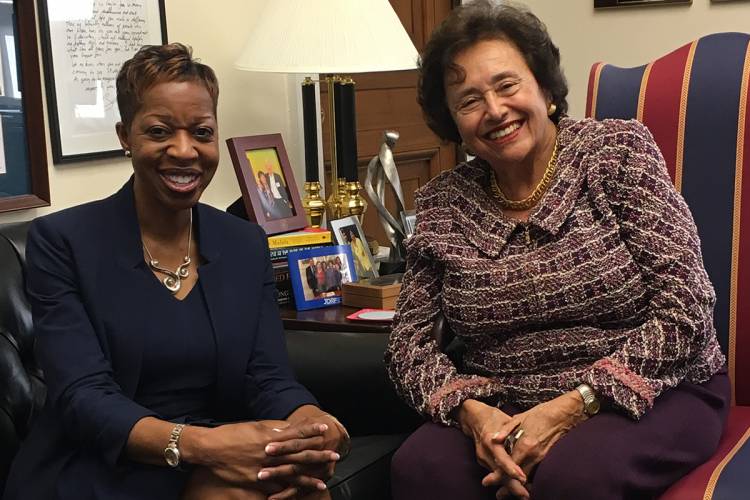
Trinity College Dean Valerie Ashby meets with Representative Nita Lowey (D-NY). Photo by Colin Colter.

Trinity College Dean Valerie Ashby meets with Representative Nita Lowey (D-NY 17th). Photo by Colin Colter.

“Part of the benefit of NSF funding is that the agency requires researchers to ensure their work has a broad impact,” said Ashby, a noted chemistry researcher. “For example, NSF proposals allow us to support undergraduate research. This is a core value at Duke and more than half of our undergraduate students conduct research with a faculty mentor. NSF also funds graduate student research and training programs. So in addition to funding major research projects led by faculty, NSF allows us to train the next generation of scientific leaders and scholars.

“NSF also prioritizes diversity, and this enables us to address issues of access. We can then ensure that the broadest base of students possible have the opportunity to participate in Duke research and educational programs. This helps us to recruit and retain the best and brightest students in STEM fields.”

Duke University was awarded roughly $38 million from the NSF in FY16. Among other initiatives, the NSF helps sponsor or fund the Center for the Environmental Implications of NanoTechnology and the Duke Lemur Center.

Dean Valerie Ashby talked about research issues and immigration with Sen. Shelley Moore Capito (R-WV).

Dean Valerie Ashby talked about research issues and immigration with Sen. Shelley Moore Capito (R-WV).

According to the National Science Foundation, Duke ranks 7th nationally among all U.S. colleges and universities in total research and development expenditures (in FY2015, the most recent year for which there is comprehensive data).

“I have had NSF funding my entire career,” said the Dean. “NSF literally launched my career in chemistry by providing support and training resources when I was a graduate student, and funding my research as a junior faculty member – which ultimately enabled me to earn tenure. NSF’s support was an endorsement of the value of the work I was doing.”

In discussions on immigration, Ashby conveyed the importance of protecting and promoting policies that allow Duke to attract and retain the best and brightest. Duke and many institutions of higher education rely on a variety of student and work visas to maintain a scholarly community that is diverse, productive and creative.

“We are a global university,” Ashby said. “More than just students are impacted by immigration policies. Faculty and visiting scholars are also impacted. We are counting on the best talent participating in our research and teaching enterprise—and immigration affects our ability to recruit, retain and collaborate.”

Ashby left lawmakers with a straightforward message: “excellence and innovation are tied to diversifying intellectual content, faculty and students.”

Deadlines and Headlines


When it comes to legislative action, there is no time like the deadline. As Congress returns this week, they face a series of decisions that shape the rest of the fiscal and legislative year. Congress has fewer than three weeks of working days in September to raise the debt ceiling and avoid a default on America’s bills. As Hurricane Harvey recovery continues, they also need to address fundamental questions about the government’s role in caring for its most vulnerable citizens. This new set of deadlines comes bundled with the unfinished appropriations work left over from the dog days of summer, the results of which will affect Duke’s future funding priorities.

The House intends to vote on an eight-bill spending package which combines the remaining appropriations bills that did not receive a vote before recess. Media reports indicate Congress may combine emergency aid for Harvey victims with stopgap government funding and the debt-limit increase upon return. Since such a funding package is likely to include much-needed emergency aid, it is unclear if President Trump’s previous threat to veto a funding package that does not include border wall funds will stand.

Meanwhile, Senate appropriators will resume work on Wednesday, September 6, including Labor-HHS-Ed and State-Foreign Operations subcommittee markups. The full appropriations committee will address both bills the following day.

The Senate Appropriations Committee still has not taken up defense spending. Senate Majority Leader Mitch McConnell (R-KY) began a fast-track process to bring a House-passed package of national security spending bills to the floor, but senators did not vote on the legislation before adjourning for recess. That measure is unlikely to garner enough Democratic support to overcome a likely filibuster.

The pending reduction to the Federal Emergency Management Agency’s (FEMA) disaster relief account is part of a massive spending bill the House considers this week when lawmakers return from their August recess. The $876 million cut included in the 1,305-page measure’s homeland security section pays for roughly half the cost of Trump’s down payment on the U.S.-Mexico border wall that the president repeatedly promised Mexico would finance.

GOP leaders are unlikely to cut disaster aid next week as floodwaters still cover Houston, the nation’s fourth-largest city, and as tens of thousands of Texans seek refuge in shelters. There is only $2.3 billion remaining in the federal disaster coffer.

In that same vein, a federal flood insurance program is the only option for millions of homeowners and expires at the end of next month. The National Flood Insurance Program expires Sept. 30 and must be reauthorized to continue operating past then.

Although not directly tied to Duke initiatives or funding priorities, flood insurance and disaster relief are likely to become bargaining chips in upcoming funding battles as Congress tries to bundle together debt limit increases, disaster funding, and appropriations.

President Trump faces many tough choices on the future of medical treatment in America. The president has threatened to pull funding for a key Obamacare subsidy, but his advisers so far have talked him out of a move that could send the individual insurance markets into a tailspin.

He faces two key deadlines in the next few weeks: whether to keep paying insurers the subsidy and whether to defend the payments in federal court. Meanwhile, insurers in most states filed final 2018 rates on August 21 amid uncertainty about the future of Obamacare subsidies and whether Republican lawmakers would drop their years-long salvo against the health care law and focus on repairing it. As important as the decision to fund insurance programs may be, funding the government will prove more so.

While the House and Senate were on recess for the past month, leaders worked on a plan to avert a government shutdown and a debt default before the fiscal year ends. The September 30 deadline is still weeks away, but Republicans were eager to settle on a strategy before lawmakers return today, September 5, with just 12 workdays before that deadline.

Even if they beat the finish line and prevent a funding lapse, leaders are already resigned to the idea of another short-term extension of current funding levels to buy more time (i.e. a continuing resolution). Without a full-year defense spending bill and a bipartisan agreement to lift defense budget caps, a continuing resolution will be needed to avert a government shutdown. If past is prologue, it could be well into 2018 before federal agencies receive updated funding.

Not all fiscal deadlines are in September. Some are self-imposed.
At the urging of his Attorney General Jeff Sessions, President Trump has decided to end the Obama-era program DACA (“Deferred Action for Childhood Arrivals”) that grants work permits to undocumented immigrants who arrived in the country as children. From current media reports and AG Sessions’ press conference, Congress will have 6 months to act on immigration reform before the program is phased out. The need to write immigration legislation adds to Congress’s full docket of upcoming milestones and will compound negotiations this fall.

The crumbs of August leave Congress with major legislative decisions. The government must be funded. The debt ceiling most likely will be raised. Immigration reform is on a tight, self-imposed timeline, and now flood insurance will rule Congress’s already full calendar. The chief driver of inaction is not just different political ideologies, but rather the gap between expectations and reality in a loaded calendar year.

Page 11 of 18

Powered by WordPress & Theme by Anders Norén