The latest news and resources from Duke Government Relations.
The DC Digest-January 16, 2026
January 16, 2026
- Senate Advances Minibus
- Education Department to Send Higher Education Staff to Labor Department
- State Department Pauses Processing of Immigrant Visas from 75 Countries
- Trump Administration Has Revoked More than 8K Student Visas
- Post of the Week!
The Duke Digest-January 15, 2026
January 15, 2026
- Pain Relief Gets an Energy Boost
- Using the Physics of Radio Waves to Empower Smarter Edge Devices
- New Partnership between Duke, National Education Opportunity Network to Bring College Courses to Low-Income High Schools
- And Much More…

The DC Digest-January 13, 2026
January 13, 2026
- Appropriations Update
- Higher Ed Associations Sign on to Amicus Brief on DOE Rate Caps
- AHEAD Committee Reaches Consensus
- Foreign Gift Reporting Portal Opens
Reviewing 2025 Federal Activity
January 9, 2026
As part of the Office of Government Relations’ ongoing work to track federal policy developments affecting the Duke community, this update provides a high-level review of legislative and administrative activity over the past several months. The summary below builds on earlier OGR coverage and highlights more recent developments across budget and appropriations, research, student aid, immigration, tax, and broader policy engagement.
Budget and Appropriations
Last fall marked the longest shutdown in U.S. history, lasting 35 days. Congress ended the shutdown by enacting a short-term funding package that extends most government operations through January 30, 2026, while providing full-year funding for the Agriculture–FDA, Legislative Branch, and Military Construction–Veterans Affairs. Additional context on the shutdown and its resolution is available in OGR’s earlier coverage.
Since then, appropriators have resumed work on the remaining FY26 bills. In early December, Senate leaders moved closer to advancing a five-bill minibus that would include Labor–HHS–Education, Defense, Transportation–HUD, Interior–Environment, and Commerce–Justice–Science, though objections within the Republican conference delayed floor action. The Senate ultimately failed to move anything forward before the holiday break, with Majority Leader John Thune (R-SD) and Minority Leader Chuck Schumer (D-NY) stating they agreed on advancing funding bills when the Senate reconvened.
Once Congress returned from the holiday break, lawmakers released the negotiated agreement for a three-bill “minibus,” which includes the Commerce-Justice-Science, Energy-Water, and Interior-Environment bills. The House is expected to take up the measure later this week. The chart below outlines the current funding status of several programs of interest to the Duke community. It illustrates Congress’s efforts to push back on the dramatic cuts to research and education programs proposed by the administration. Negotiations are expected to continue on the remaining FY26 measures ahead of the January 30 funding deadline.
Research
Building on developments OGR has tracked throughout the year, federal research policy continues to be shaped by a mix of administrative priorities, congressional action, and litigation.
Earlier OGR coverage summarized the administration’s FY27 research and development priorities, as well as a series of agency actions affecting grantmaking, indirect cost policies, and research oversight.
Congress passed, and President Donald Trump signed into law, the FY26 National Defense Authorization Act (NDAA) just before the end of the year. More details on provisions of interest, including top-line budget numbers, indirect cost rates, and other relevant information, were covered in a previous DC Digest.
Other recent activities have largely reinforced these trends, as OGR continues to monitor agencies implementing guidance and courts issuing decisions that affect research funding, including facilities and administrative costs. In September, Commerce Secretary Howard Lutnick proposed imposing a 50 percent innovation tax on revenues universities earn from licensing their discoveries to the private sector. Although no concrete action is currently scheduled on this proposal, OGR is closely monitoring this issue and will provide updates as needed.
Additional Duke-specific resources related to the research landscape can be found on the Office of Research and Innovation’s website.
Student Aid
Following the developments in student aid covered earlier, federal activity in this area has accelerated through both negotiated rulemaking and congressional engagement.
OGR previously summarized major student aid provisions enacted under reconciliation and early signals from the Department of Education regarding implementation. We have also covered the Congressional response to proposed limits on graduate lending for medical professions in detail.
More recently, the Accountability in Higher Education and Access through Demand-driven Workforce Pell (AHEAD) Committee reached consensus on the Department’s complete package of proposals discussed during its first negotiated rulemaking session, which primarily focuses on establishing a new Workforce Pell program. The consensus package addresses program classification, value-added earnings calculations, completion and placement metrics, and clarifications regarding eligibility and program purpose.
Relatedly, though not part of the negotiated rulemaking session, the Department introduced a new earnings indicator within the FAFSA process that alerts students when graduates of a listed institution earn less than a typical high school graduate, based on College Scorecard data. The Department has released additional information, including a list of institutions identified under the new indicator.
The AHEAD committee has reconvened for its second session, which will focus on additional issues enacted under reconciliation, including accountability measures, financial value transparency, and gainful employment and Pell eligibility exclusions tied to high Student Aid Index values.
In other recent student aid news, the House Committee on Education and the Workforce has advanced several higher education bills related to financial aid award letters and college cost transparency. While no floor votes are currently scheduled, the activity reflects continued congressional interest in cost and value disclosure issues.
Immigration
As previously detailed in our blog, immigration policy developments over the past year have continued to affect international students, scholars, and employees across higher education.
Since that coverage, U.S. Citizenship and Immigration Services (USCIS) announced new rules that shorten the time foreign workers may remain employed in the United States before renewing their work permits. Under the changes, refugees, asylees, and several other non-citizen groups must seek reauthorization every 18 months or less, with some facing annual renewals.
In addition, the Department of State implemented new procedures for vetting the online presence of H-1B and H-4 visa applicants, expanding screening practices previously applied to F, M, and J visa categories. President Trump has also expanded the list of entry restrictions, adding 20 countries to the list, which now includes 39 nations under full or partial bans.
Looking ahead, the Department of Homeland Security is preparing a proposed rule that would significantly revise the Optional Practical Training program. The rule, listed on the regulatory agenda, is expected to address oversight, fraud prevention, and national security considerations, with publication anticipated in early 2026. Other immigration-related rules affecting H-1B visas and duration of status remain pending.
Tax
Federal tax policy affecting higher education has continued to evolve through both legislation and agency guidance.
As covered previously by OGR, reconciliation legislation revised the higher education endowment tax by adjusting institutional thresholds and creating tiered tax rates. The Senate’s version reshapes the tax on large university endowments:
- Exempts schools with fewer than 3,000 tuition-paying students, up from the House’s 500-student threshold.
- Introduces a tiered tax structure with rates from 1.4% to 8%, depending on endowment size.
In early January, the Treasury Department will begin developing regulations that will govern the tax changes and issue final rules later in 2026.
Policy Engagement
Throughout the year, the Duke community actively engaged with policymakers both in Washington, D.C. and on campus, through a diverse set of programs, convenings, and meetings. These activities drew expertise from all parts of the university, working to build purposeful partnerships with lawmakers, think tanks, and policy professionals to elevate Duke’s presence and impact in D.C.
Among the D.C. engagement, Duke faculty and staff brought their expertise directly to policymakers on the Hill, including Dr. Emily Edwards with the Duke Quantum Center, who hosted a briefing with other academic leaders on the basics of quantum science. The leadership of the Triangle Universities Nuclear Laboratory (TUNL) visited Capitol Hill to highlight the importance of federal funding to the work at TUNL and the development of the future nuclear workforce. Also on the Hill, Dr. Ashley Ward held a briefing highlighting the efforts of the Nicholas Institute Heat Policy Innovation Hub. The briefing included opening remarks from Senator Mark Kelly (D-AZ).
Professors Dan Scolnic and Michael Troxel, assistant professors of Duke’s physics department, visited several offices in the North Carolina delegation to discuss the Roman Space Telescope mission.
Among engagements in Durham, several lawmakers connected with campus both through in-person visits and virtual remarks. Congressman Greg Murphy (NC-03) took a tour of the Duke School of Medicine and learned more about its efforts statewide to expand patient care and access, as well as the North Carolina’s first and only freestanding children’s hospital.

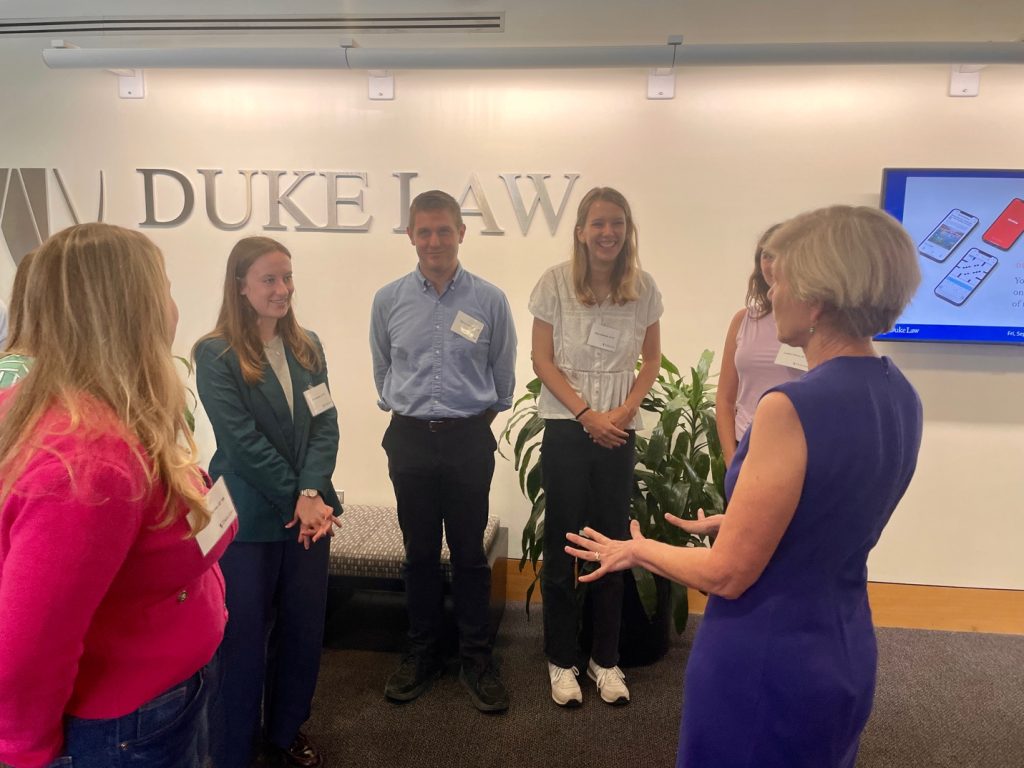
Congresswoman Deborah Ross (NC-02) paid a visit to one of Duke’s NIH-funded research labs, met with President Vincent Price and lunched with Duke Law students.
Duke’s own representative, Congresswoman Valerie Foushee (NC-04), provided welcome remarks at this year’s inaugural Athena Summit, which showcased Duke’s leadership in artificial intelligence and edge computing
What’s Next?
The Office of Government Relations will continue to monitor all aspects of federal policy activity of interest to Duke. To receive regular updates from our office, sign up for our DC Digest here.
The DC Digest-January 9, 2026
January 9, 2026
- House Advances Three Appropriations Bills
- National Quantum Initiative Act (NQIA) Reauthorization Introduced
- NIH Agrees to Reconsider Frozen and Denied Grants
- Department of Education Accountability Negotiated Rulemaking Update
- Education Department Reinstates Civil Rights Workers
- Office of Government Relations Federal Activity Blog
- Post of the Week!
The Duke Digest-January 8, 2026
January 8, 2026
- A Springlike Day Marks the Start of the Spring Semester
- From Coursework to Patient Care: Duke Design Health Team Innovates POTS Treatment
- From Patient to Pathologist
- And Much More…

The DC Digest-January 6, 2026
January 6, 2026
- Appropriations Committee Releases Minibus Bill Text
- Court Upholds Ruling to Block NIH Cut to F&A
- Education Department to Start Garnishing Wages of Student Loan Borrowers in Default
- DOJ: Education Department’s Race-Based Grants Unconstitutional
- Judge Sides with Trump Administration Over $100K Visa Fee
The DC Digest-December 23, 2025
December 23, 2025
- Senate Republicans Release FY26 Homeland Security Funding Bill
- House SST Hearing on Research Security
- DOE Under Secretary for Science Appears Before House SST Committee
- Trump Administration Appeals Harvard Ruling
- Senate Clears Additional Federal Agency Nominations
- Trump Nominates Joshua Rudd to Lead NSA
The DC Digest will return after the new year. Happy Holidays!
The DC Digest-December 19, 2025
December 19, 2025
- Senate Leaves Town without Minibus Action
- Trump Signs NDAA
- Administration Plans to Dismantle NCAR
- NSF to Implement Organizational Realignment
- Senators Budd and Fetterman Introduce Legislation to Create National AI-Enabled, Automated Lab Network
- NSF Announces New Initiative to Bolster Research Organizations
- Trump Expands Travel Ban to 39 Countries
- Bipartisan Group of Lawmakers Push to Classify Nursing as a Professional Degree
- Post of the Week!
The Duke Digest-December 18, 2025
December 18, 2025
- New Duke Homepage Highlights Duke’s Presence in North Carolina
- AI Learns to Build Simple Equations for Complex Systems
- Duke–Industry Materials Connect: 2025 Kickoff Event Brings Together Regional Industry and Duke Materials Science
- And Much More…