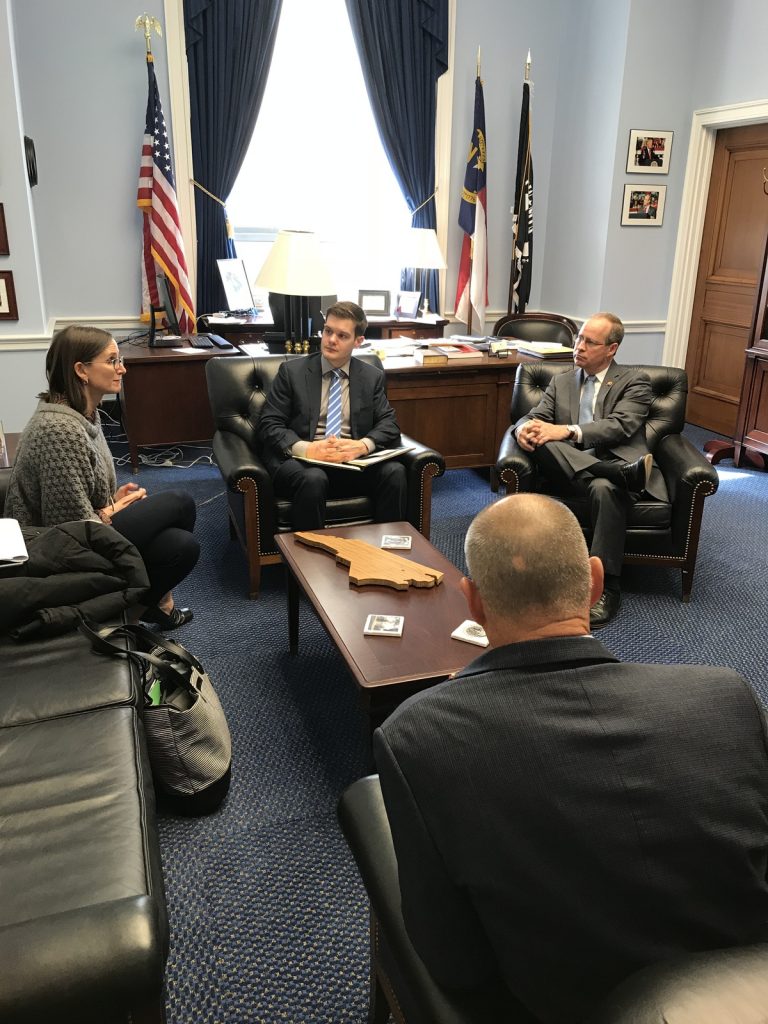
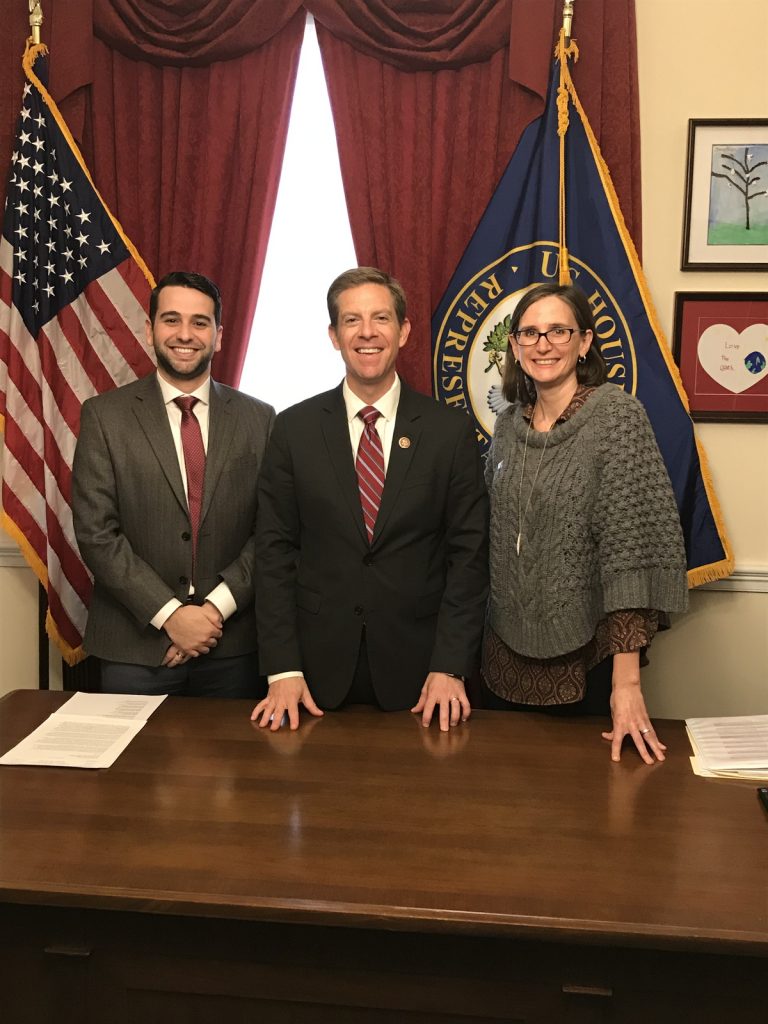
U.S. Representative for North Carolina’s 4th District, David Price (D-NC), visited Duke on February 18th to meet with faculty, learn more about Duke’s expertise and innovation in homeland security and see the great impact that federal research funding has on the state of North Carolina.
Representative Price started off his day with the Pratt School of Engineering, where he received an update on a $5.83 million contract from the Department of Homeland Security (DHS) to reinvent airport security screening. Professors Joel Greenberg, Michael Gehm and Anuj Kapadia, associate professor of radiology, gave Rep. Price a tutorial of their airport security scanner, which uses a unique technology to help determine the molecular signature of an object to further refine the screening process. This technique can provide a more accurate and efficient screening of liquids and explosives and can be used for other materials such as illegal opioids, which is another priority for DHS. The scanner has capabilities far beyond the scope of security, and will soon begin testing at the Duke Hospital as a means to search for tumors in the body.
At the Sanford School of Public Policy, Rep. Price engaged in a roundtable with Duke professors, David Schanzer, David Hoffman and Vincent Conitzer to discuss Duke’s wide-range of expertise on homeland security topics, including: combatting violent extremism, cybersecurity and artificial intelligence.
We are honored to have @RepDavidEPrice on the @DukeU campus today! Follow along for updates on the Congressman's visit ⬇️
Editor’s Note: Jeffrey Krolik, professor of electrical and computer engineering recently discussed his experience as Duke’s first Defense Advanced Research Projects Agency (DARPA) program manager, a position he held for the last five years.
Originally posted here by the Pratt School of Engineering, this blog post highlights Krolik’s draw to public service through his role as a program manager and the important role of science and technology programs to the mission of the Defense Department.
Jeffrey Krolik stands with the two leads from Northrop Grumman before the first test flight of the mobile wireless communications project he helped lead during his time at DARPA.
HOW DID YOU BECOME A DARPA PROJECT MANAGER?
I’ve been engaged in DARPA projects throughout my career—most of them focused on sonar and radar signal processing—and so people who knew me there asked me about coming to DARPA to be a program manager. At this stage in my career, I thought it would be a way to have a greater impact on solutions to some important national defense challenges, so I expressed interest and I was selected. The Dean and the ECE Chair at the time agreed that it would be very worthwhile public service, so I was granted a government service leave from Duke to take the position.
I moved to Washington DC because my job involved constant interaction with industrial, government and military officials, often in secure facilities.
WHAT EXACTLY DOES IT MEAN TO BE A DARPA PROGRAM MANAGER?
DARPA program managers are selected because they often bring new ideas to solve difficult defense-related problems. Almost everyone at DARPA is there for a limited term, typically three to five years, so in order to see results while you’re there, you feel pushed to have projects progress as fast as possible. Program managers develop ideas for projects with the help of experts all over the country and present them to the Director for approval.
One of the best things about being at DARPA is that virtually everyone you reach out to wants to help you develop ideas for projects. Once the project is approved, a solicitation is published and proposals from teams are evaluated based on formal selection criteria, often with an emphasis on the novelty of their solution. In the Strategic Technology Office of DARPA, where I was employed, the focus is on the development of large systems beyond fundamental research.
Because everyone at DARPA is there for a limited time, quite often the execution of a project extends beyond the tenure of the original program manager, so the management transitions to someone new. During my time at DARPA, I started four programs and took over two programs started by others. At one point, I was managing four projects at once, which was incredibly intense, especially since most involved field experiments executed by different teams.
WHAT WAS THE MOST INTERESTING PROJECT YOU WORKED ON?
One of the most interesting projects I initiated involved putting up a series of nanosatellites to improve the performance of over-the-horizon radar. Nanosatellites typically weigh less than 25 pounds and are measured in size by the number of four-inch “cubes” they occupy. Our so-called “CubeSats” were the first of their kind for this application and posed many unexpected challenges with respect to spacecraft attitude control. I attended the launch of our first spacecraft on a Minotaur rocket from Cape Canaveral which was very exciting. Watching a rocket launch is a lot more fun knowing that your payload is going into orbit!
I also started a drone surveillance program whose aim is to detect and track small drones in urban environments. The program involves a fusion of multiple sensors. The project is aimed at drone surveillance for troops operating outside the US, but there has also been a lot of interest for using these systems for drone surveillance in the US.
WHAT WOULD YOU SAY WAS THE MOST SUCCESSFUL PROGRAM YOU PURSUED?
Probably the most successful program I managed was one that I finished but didn’t start. Its goal was to achieve wireless data transfer from an aircraft to a ground station at fiber-optic data rates, which are speeds of at least 10s of gigabits per second. Compared to the fastest commercial mobile wireless data rates of less than 100 megabits per second, that’s insanely fast. We easily broke the previous world record by demonstrating data transfers at more than 40 gigabits per second at distances greater than 30 km using large bandwidths at millimeter-wave frequencies, many bits per symbol, and multiple-input-multiple-output (MIMO) antennas and waveforms.
HOW ABOUT THE MOST HEADACHE-INDUCING PROGRAM?
The most unusual program I managed had a goal to provide the US Navy with the ability to pre-position assets underwater. For the assets to survive until needed, the idea was to store them at the bottom of the ocean in pressure vessels. When needed, a command would be sent to release the pressure vessel, which would then float to the surface and deploy its payload.
Besides there being all kinds of issues with how to ensure the vessels could withstand the intense pressure at depths of over 4,000 meters and the challenges of communicating with it, we attracted some crazy media coverage. The program also appeared to inspire an NCIS television series episode about “pre-positioned assets or PPA’s.” The TV script was a murder mystery involving deeply submerged Navy pressure vessels supposedly used to store illegal drugs! The fictional program was much more sensational than the real program.
WHAT WERE YOUR BIGGEST TAKEAWAYS FROM YOUR TIME AT DARPA?
I learned that there are a lot of very dedicated and talented people in the defense department and the military. Overall, I was very impressed by the professionalism of the people who choose to serve their country in this way.
I also learned to appreciate the importance of teams and what it takes to be both a good team leader and team member. As a program manager, I was responsible for program leadership and was also held accountable as a government team member. Developing complex new systems is hard. I found that just getting a lot of smart people together isn’t enough. They all must be able to work effectively together, which requires leadership and accountability.
WHAT ARE YOUR RESEARCH PLANS NOW THAT YOU’RE BACK AT DUKE, AND DID YOUR TIME AT DARPA INFLUENCE THEM AT ALL?
I’m hoping to branch out beyond traditional military applications of radar and sonar. In the last few years, new commercial millimeter-wave radar and acoustic sensor arrays have opened up a whole host of new sensing possibilities for signal processing research. Right now, we’re looking at everything from radar signal processing for human health assessment to sensor array processing for coherently combining a set of widely distributed microphones, e.g. in smart speakers, to improve speech processing in noisy environments. In addition, I look forward to initiating new collaborations and starting new projects with some of the great faculty we have at Pratt.
On Tuesday, November 19th Duke in DC and Duke’s Office of Licensing and Ventures (OLV) co-hosted a congressional briefing titled, “University Innovation and Entrepreneurship Ecosystems.”
OLV Executive Director Robin Rasor and New Ventures Director Rob Hallford traveled to Washington, D.C. to speak to nearly 50 congressional staff and other stakeholders about research universities’ entrepreneurial environments, and how the federal government plays a role in stoking innovation and local economies. The briefing coincided with “Innovation Month” at Duke and Global Entrepreneurship Week.
Melissa Vetterkind, director of Duke’s Office of Government Relations, said that the Capitol Hill briefing was a great forum to highlight some of the ways Duke and the federal government support our innovative faculty. Vetterkind explained, “There’s always a lot of excitement when a new start-up launches, and this was an opportunity to highlight the certain touchpoints along the innovation pipeline, from the federal investment in research on the front end, to the institutional support to help faculty to cross the “valley of death” and the overall university technology transfer framework created by the Bayh-Dole Act.”
Rasor also discussed the booming sectors within the entrepreneurial space that she is currently observing. Both medicine and technology have remained a key focus for Duke inventors, however, OLV is now seeing a major explosion in the digital space with new software innovations. In fact, digital innovations now make up 40% of OLV’s total deals today.
OLV’s Annual Report highlighted Duke’s banner year with 16 new start-ups created, 2 IPOs and $58 million in revenue during FY2019. Both Robin and Rob conveyed their excitement about the trajectory of entrepreneurship at Duke and their forward-looking goals to pioneer innovation in the years ahead.
A common theme that permeated the event was the positive impact that Duke and other universities in the Research Triangle have had on North Carolina’s economy. The vast majority of spin-outs from Duke remain in the Triangle area, with 91% of new start-ups located in NC over the past two years, ultimately driving revenue back into the state’s economy.
Rasor and Hallford affirmed that OLV’s overarching goal is to benefit society by fostering innovation. Additionally, for the state of North Carolina, OLV aims to create a booming ecosystem that will attract highly skilled faculty, enhance the region and encourage more individuals and companies to stay in the Triangle because it is, “a great place to do business.” When asked what they would like to see more from the federal government, Rasor said that above all else, it is essential for the government to, “continue funding for basic research.”
Toddi Steelman, the Stanback Dean of the Nicholas School of the Environment recently spent a morning on Capitol Hill for a round of meetings that highlighted faculty expertise at the Nicholas School and the need for evidence-based decision-making.
The dean highlighted the importance of continued federal funding for research to enable university researchers at the Nicholas School and elsewhere to pursue the advancement of environmental science and technology to benefit policy matters ranging from climate change, coastal resiliency and environmental health. As a result of this investment, Dean Steelman explained, lawmakers are able to draw upon accurate research and translate it into effective policy solutions.
.@DukeEnvironment Dean Toddi Steelman (@EnviroWonk) visited DC last week to meet with several members of Congress. While in town, she spoke with us about the importance of evidence based research in the lawmaking process. pic.twitter.com/KBUUUGmBiu
Dean Steelman began the morning with one of the newest members of the North Carolina congressional delegation, Representative Greg Murphy, M.D. (R-NC). Rep. Murphy recently won a special election to represent the Third Congressional District in North Carolina, which covers a large portion of the coast and is home to the Duke Marine Lab.
The two discussed many of their common interests regarding the coastal region of North Carolina including building coastal resiliency before, during and after storms impact communities. Steelman shared the wide range of expertise at the Nicholas School, including research from the Duke Marine Lab, and the school’s outreach to down east counties. Noting Rep. Murphy also represents Camp LeJeune, Steelman also highlighted some of the ways Duke Marine Lab researchers collaborate with the Department of Defense on issues impacting coastal land management and marine mammals.
Steelman also met with two Duke alums currently serving in Congress, Representatives Mike Levin (L’05) (D-CA) and Scott Peters (T’80) (D-CA). Those conversations focused in part on the wildfires ravaging California and potential policy considerations, which is one of Steelman’s areas of expertise. Joining the meeting with Rep. Levin was Duke Environment Leadership Masters of Environmental Management student Jonathan Gilbert, who also serves as Levin’s legislative director, and staff from the House Select Committee on the Climate Crisis, on which Levin serves.
As the school year is beginning and the government’s fiscal year is ending, expectations for an eventful fall are coming to fruition. President Trump signed a 2-year $2.7 trillion budget deal at the beginning of August and Congress left town for the month for their district work period. As the upcoming presidential election heats up, we will likely see frontrunners for the Democratic party nomination emerge, and President Trump shift into re-election mode for 2020. Economic growth will likely be impacted by Chinese relations and trade uncertainty moving forward, meanwhile, there are whispers of a potential recession around the corner.
As Congress returns to the nation’s capital in earnest following Labor Day, we will learn more about the implications of the budget deal as government funding runs out at the end of September.
Budget & Appropriations
Although the budget deal passed successfully with bipartisan support, we are paying close attention to Congress to see how the remainder of 2019 will play out. The budget deal for the next two years lifts spending caps for FY 20 and FY 21 and extends the debt limit. This passage also effectively ends the austere budget caps and sequester threat put in place by the Budget Control Act of 2011, which was set to expire in 2021. For Duke we expect this to mean more spending on discretionary items like research.
On the tails of the longest government shutdown in U.S. history, this agreement could be viewed as a sign of hope for a smoother year but much work remains in the coming weeks before the end of the current fiscal year on September 30th.
Prior to the August district work period, the House of Representatives passed ten of its twelve funding bills. The Senate stalled pending a budget agreement. Senate action is expected to kick into high gear in the coming weeks in the hopes to pass as many bills as possible before the end of the month.
House appropriators will be busy as well since the House-passed spending bills had assumed a higher spending limit for FY 20 than is contained in the Bipartisan Budget Act. Adjustments to these allocations will be necessary prior to conference negotiations. The tight timeline for finishing the FY 20 appropriations process in September means we might see a continuing resolution until the holidays.
Science Security and Foreign Influence
Concerns over the protection of intellectual property and national security from foreign influence in academia continue to receive a good deal of attention on Capitol Hill, within the administration, and in the media. Just during the summer months, the NIH, NSF and Department of Energy released guidance related to reporting requirements for outside support and participation in foreign talent recruitment programs. Additionally, the U.S. Department of Education announced investigations into four schools over the reporting of foreign gifts.
Congress continues to hold hearings on these topics and several legislative proposals have been introduced in response. The annual National Defense Authorization Act has been a focal point for many of these proposals and both the House and Senate-passed versions contain language related to science and security issues. In an effort to combat some of the more onerous proposals, the House bill contains the Securing American Science and Technology Act, which has been endorsed by the higher education community, including Duke. We expect discussions concerning foreign influence to continue in Congress and science agencies throughout the fall.
Immigration
The House passed “Fairness for High Skilled Immigrants Act of 2019”. This act removes a cap of percent quota of immigrants from one country per year for employment-based visas. The bill now sits in the Senate with the Judiciary Committee.
Moving into the fall, we look to Supreme Court for the upcoming Deferred Action for Childhood Arrivals (DACA) case. While a decision is not likely to come until 2020, the courts could hear the case as early as October.
Higher Education
Momentum has slowed considerably for a full-bipartisan reauthorization of the Higher Education Act. In the Senate there are three main sticking points: accountability, affordability, and Title IX. Over in the House conversations have pointed towards a December markup on a likely partisan bill in the Democratic controlled committee.
Taxes
In June, the U.S. Department of the Treasury released guidance on the endowment tax rules approved in 2017. The implications of the excise tax are complex for universities and the Office of Government Relations is continuing to work to provide clarity on implications for Duke.
The technology supporting America’s military needs a software update. Although cyber-attacks and ransomware rule news outlet front pages, the U.S. military’s most pressing needs are more routine. Questions of how to design and budget training regimens, how to communicate medical information, and how to ‘hear’ terrorist propaganda on social media are all top of mind for local military unit commanders taking part in a special Department of Defense (DOD) program, as part of DOD’s National Security Innovation Network (NSIN), meant to upgrade the armed forces.
As part of NSIN’s work, Hacking for
Defense (H4Dä) puts the ‘idea architecture’ of a
university system to work solving some of the military’s most intractable
problems.
Duke Hacking for Defense, which just
completed its inaugural year, is a university-sponsored class
that allows students of all ages and disciplines (and a handful of alumni as
well) to develop an understanding of the problems and needs of government
sponsors in the Department of Defense.
H4D uses the ‘Lean Startup’ method to
address technological problems in national security. Developed by Steve Blank
at Stanford University, the ‘Lean Startup’ methodology encourages
experimentation over planning, ‘customer’ feedback over prediction, and
iterative design over traditional end-product unveiling.
Working directly with their military liaisons, the students
developed and prototyped solutions to the sponsor’s needs within one academic
year.
Green Beret and former Assistant Secretary for Public and
Intergovernmental Affairs at the United States Department of Veterans Affairs
Tommy Sowers (Sanford, ’98) is one of two co-instructors for Duke’s Hacking for
Defense Program, alongside Duke Entrepreneur in Residence Steve McClelland
(Pratt ’95), former product lead at Twitter and Yahoo!. Both have led venture
backed technology companies.
This program is unique for a variety of reasons, argued
McClelland. “Within
the university, it is rare to have a course with so many diverse ages, majors,
schools and programs represented.” McClelland explained. “Our
multi-disciplinary teams also have to work closely with people outside the
university which requires a new set of organizational and teamwork skills.”
Another
one of Duke’s assets in its operation of this program is simply its geography.
“One of Duke’s strengths, is that [we] happen
to be in spitting distance of the largest army base and the largest marine base
in the world,” noted Sowers. Camp Lejeune is the world’s largest Marine base
and Ft. Bragg is the world’s largest Army base. Duke’s Hacking for Defense program
brings those worlds a bit closer.
The seven Duke H4D groups each paired either with a Marine unit, an Air Force unit, or with one of five Army units. All the Army units were special operations groups.
They solved a real-world, knotty, difficult national security project with real consequences.
Duke H4D co-Lead Tommy Sowers
Because of the fluid nature of their operational theaters, special operators tend to be entrepreneurial and to work well in ambiguity – perfect fits for the ‘Lean Startup’ model of solving problems, argued Sowers.
Through hundreds of interviews, dozens of
site visits and team-building time between the civilian and military groups,
these teams addressed some of the most defiant problems special operators face
every day.
On the last day of the program, the
groups each present their solution to a crowd of interested specialists,
academics, military sponsors and investors. The “Shark-Tank” style pitch allows
the students to petition the audience on the possible commercial viability of
their project as well as the potential further use in military situations.
One team created a software solution they
called Bullet Train, whichseeks to streamline the training
schedule decision-making of special forces units. A unit of 12 special forces
soldiers may face a variety of different scenarios and environments at any
given time. Further, the unit also faces budgetary constraints in designing and
implementing a training regimen for those deployments. Currently, unit
commanders, the ones who plan and manage training, must seek training best
practices from other unit leaders. They also have to design that training
regimen and all the equipment it will need to fit the military’s draconian
budgetary standards. And since the military favors promoting and advancing
talent, much of a unit’s best practices leave with the unit commander upon
promotion.
Bullet Train wants to hold on
to that institutional training knowledge and to streamline access to it for
other unit commanders. The software even pre-populates the necessary government
forms and assembles a proposed budget. With its searchable catalog of training
concepts, best practices, vendors (government contractors that offer
specialized skills such as language training), Bullet Train gives unit commanders the ability to learn from and
build on the collective training and procurement knowledge of their peers.
The inventors of Bullet Train also see the possibility for their program’s use with emergency
medical services personnel and with educators.
Another project team developed a natural
language processing social media integrator called Watchword. Watchword
combines and analyzes the context in which words used (in English and Arabic)
appear on social media. It then uses those frequencies to identify potential
group loyalty.
The military sponsors for this software
are so enthusiastic about its possible success, that the program will be
deployed to Syria this summer, 2019.
From telemedicine software to natural
language processing social media aggregators, Duke’s Hacking for Defense groups
have provided much more than simply a learning experience for students. When
asked about the uniqueness of this program, Sowers noted that “instead of a
paper, we have 7 solutions that were actually adopted.”
“This was by far the most incredible class I’ve ever taught,” Sowers continued. “Both in the personal growth of the individual students and in what they did… they solved a real-world, knotty, difficult national security project with real consequences.”
In order to explain the long history behind Venezuela’s current crisis, former Ambassador to Venezuela and director of Duke’s Center for Latin American and Caribbean Studies Patrick Duddy delivered a Capitol Hill briefing, March 1. Duddy spoke to an audience of congressional staff, foreign embassy personnel, and federal employees at the Duke in DC-sponsored program.
Duddy speaking to congressional staff March 1. Photo Credit: Duke in DC staff
In addition to Duddy’s diplomatic expertise, the program benefitted
from Duke’s relationship with the Department of Education’s Title VI program. Duke’s
Center for Latin American and Caribbean Studies (CLACS), which Duddy directs in
consortium with the University of North Carolina Chapel Hill, receives grant
funding as a Title VI National Resource Center. The research done at CLACS directly
contributed to his thorough and continued expert insights into the current
crisis in Venezuela.
As part of the Department of Education’s effort to understand
issues in world affairs, National Resource Centers such as CLACS “establish,
strengthen, and operate language and area or international studies centers that
will be national resources for teaching any modern foreign language.” Continued
funding of these centers helps not only train future federal employees with
international language and cultural competency, but also, as evidenced by this
briefing, contribute more immediately to the knowledge and understanding for
Congressional staff and other federal employees.
According to Duddy, international observers have seen cracks in the
Venezuelan system since 2007. The year 2014 saw epidemic street protests
against the government. In December 2015, the Opposition Democratic Unity party
won two-thirds majority in parliamentary elections. In 2016, more protests
called for the removal of president Maduro, blaming him for the economic
crisis.
The Venezuelan constitution provides for situations in which the president is either incapacitated or illegitimate. In such case, the head of the National Assembly becomes the interim president until new elections can be held. Juan Guaido has already received some international recognition as the legitimate interim president, per his role as Opposition leader. The United States, Canada, many Latin American countries and some European countries recognize him as the legitimate leader of Venezuela.
The
role of international actors in Venezuela’s situation was the focus of an event
on Duke Campus, March 6. Keith Mines, Director of Andean Affairs in the State
Department with responsibility for managing U.S. relations with Colombia,
Venezuela, Ecuador, Peru, and Bolivia, spoke on the uniqueness
of the situation in Venezuela from a regional perspective. In
addition to his extensive diplomatic experience, Mines has worked in conflict
and conflict-recovery zones around the world. His trip to Durham serves to
strengthen the diplomatic, academic and educational ties all needed to
understand a situation as complex as Venezuela’s.
Once
the model of democratic government and ‘Modern’ Latin America, Venezuela has
succumbed to its own worst instincts. From high-level corruption and police
brutality to drug and food shortages, Venezuela must now resolve its political
crisis before it can address its economic one, argued Duddy. When those in
power ascend and maintain that strength by rewriting the rules of the economy
in their favor, political evolution may need to presage economic change.
Patience and international pressure, according to Duddy, are key to righting
Venezuela’s long crisis of expectations and political malpractice.
Professor Walter Sinnott-Armstrong lectures on the ethics of Lethal Autonomous Weapons (LAW). Photo Credit: Duke Government Relations
February 15, 2019
The problem with artificial intelligence is that is still fairly stupid. It is prone to bias and misunderstands context clues. It misreads street signs and confuses humans for robots. But humans also succumb to biases and false positives. Humans find patterns where they don’t exist and miss patterns where they do. When it comes to the role of Congress in regulating America’s A.I. ecosystem, human and artificial intelligence must work together to check each other’s weaknesses.
The solution to this imbalance lies in understanding the strengths of both humans and machines, argued three Duke University professors in a briefing for Congressional staff on Feb. 15. Vincent Conitzer, Kimberly J. Jenkins University Professor of New Technologies; Walter Sinnott-Armstrong, Chauncey Stillman Professor of Practical Ethics in the Department of Philosophy and the Kenan Institute for Ethics; and Nita Farahany, Professor of Law and Philosophy all spoke at the seminar.
Meant to highlight the central ethical questions of A.I.
research, the lunchtime event coincided with President Trump’s recent Artificial
Intelligence Executive Order (EO). Trump’s EO aims to educate
workers in STEM fields, increase access to cloud computing systems, increase
access to the data needed to build A.I. systems and to promote cooperation with
friendly foreign powers. It did not set aside new funding for these priorities.
Professor Conitzer began the program with a problem: the
inability of A.I. to not choose. He
used a Winograd Schema, a sentence with an ambiguous word that can be resolved
in two or more ways, to show how humans employ ambiguity. The English language
does not assign genders to plural pronouns. So, if Google Translate moves the
sentence “The men agreed with the women because they are right” into Spanish,
it will have to translate “they” as either masculine or feminine.
Google Translate often defaults to masculine pronouns – possibly reflecting the selection data that trained the algorithm. Google’s artificially intelligent language translation makes decisions humans either avoid or can use context clues to properly address. That algorithmic bias, however, also highlights the problems humans have in resolving ambiguity and asks what that means for the digital future. Seen as a type of human to A.I. checks and balances, it may be exactly A.I.’s failures that help resolve some of our own.
At present, A.I. systems don’t embrace ambiguity the way humans can and don’t understand context clues either. In a way, that precision of artificially intelligent systems to hone in on a problem or trend may help humans better understand biases and logical fallacies.
A.I.’s future doesn’t only promise controlled human bias and
progress, however. Some popular literature such as the Oxford University
philosophy professor Nick Bostrom’s book Superintelligence
asks what happens when artificial intelligence surpasses general human
intelligence. Bostrom predicts a dire future where A.I. reaches beyond human
control and supersedes the wishes of humankind.
When asked about the possibility for a
superintelligence-type A.I. takeover, professor Conitzer redirected the
conversation from long-term predictions to near-term threats. He felt the real
threat to human liberty is not from an A.I. acting autonomously, but from a
human using A.I. systems to control other humans.
Conitzer noted that A.I. might enable large-scale
surveillance and manipulation of societies, including through the use of ‘deep-fakes’
[A.I.-generated fake images and videos]. “It’s become incredibly easy to
doctor images and video in realistic ways,” he warned.
The potential of A.I. to create society-wide effects has led
some countries to lead from the top with national strategic plans, such as
President Trump’s A.I. Executive Order.
In addition to plans, however, several G20 countries have committed significant resources to the research and development of A.I. China and the U.S. still lead in A.I. deployment and R&D, with the U.S. taking a private-sector-led approach and the Chinese a public-sector one.
The investments in federal R&D differ greatly. By fiscal
year 2017, the U.S. had spent 2.5 billion USD on federally-funded A.I.
research. By 2020, the Chinese plan to invest 70 billion USD in A.I. R&D,
and by 2030, the Chinese
plan to invest a total of 150 billion USD in artificial intelligence
R&D.
One participant asked Farahany whether the private or the public sector should take the lead in funding A.I. research. “Because A.I. is still in such a nascent phase of its development,” Farahany responded “and because we as a society are going to increasingly face ethical and legal dilemmas from its use and development, there is an important role for government in the field. They [federal research agencies] have a chance to be at the forefront of and to help spur greater innovation in A.I., and we should make sure they have the resources they need to do so.”
Professor Sinnott-Armstrong also touched on the role of
government in providing definitions and direction for the use and deployment of
A.I., particularly in the ethically uneasy use of lethal autonomous systems.
The Department of Defense has adopted a fairly precise definition of both
artificial intelligence and lethal autonomous weapons. The DoD took a top-down
ethical approach instead of a bottom-up one. This intra-agency direction,
Sinnott-Armstrong advised, may not work for government agencies that prefer a
networked and not a chain-of-command approach.
Because of their increased precision, lethal autonomous weapons
systems may be more moral than traditional human-to-human engagement. Sinnott-Armstrong
argued, though, that autonomous weapons systems should not be deployed by the
government too quickly, and their performance could be improved by
incorporating ethical oversight into the artificial intelligence. “When
properly implemented, future autonomous and semi-autonomous weapons might be
able to increase effectiveness and deterrence while also reducing mistakes and
civilian deaths,” he suggested.
In an ironic twist, the professors noted that the advent of
A.I. may require even more human discernment and analysis than now required –
in both military and non-military uses.
Several audience members asked about the ethical dilemmas of
predictive policing. Predictive policing uses large amounts of demographic data
to identify crime trends. Predictive policing offers one of the most acute
examples of ways A.I. can either check human bias or accelerate it.
For example, an A.I. predictive policing software system may
predict a result 80% of the time given a certain scenario. In such a case, it
is similarly true to say ‘100% of people who drink water will die.’ There may
be a 100% rate of correlation, but there is nothing valid in the relationship
between the drinking of water and death. Links can be technically true and yet
conceptually unhelpful at the same time.
Similarly, an A.I. predictive policing system can correlate
variables such as race, class and geography and still not understand their causal
relationships.
One trend resonated through the entire program: patterns
alone do not bare objective truth. As each professor noted in their
presentation, human analysis of a pattern reveals truth. The problem with
artificially intelligent programs is that many of them ‘learn’ from reams of human-generated
data. If the data lacks quality, the results will too. Human and artificial
intelligence have much to offer each other, but only if they ask the right
questions.
As Congress returned to Washington, D.C. January 3, they returned to the partial government shutdown. This shutdown, now the longest in the nation’s history, results from a fight over funding for a border wall and may portend future funding confrontations and legislative brinksmanship. A divided Congress featuring Democrats in control of the House of Representatives will no doubt increase resistance to some of the Trump Administration’s funding and legislative priorities.
Beyond the early funding focus, the 116th
Congress will look at a host of issues of interest to Duke’s research community
– such as artificial intelligence and healthcare. Below are highlights of some
of the issues directly impacting Duke as an institution and what the Office of
Government Relations watches and engages on Duke’s behalf for the first half of
2019.
Budget & Appropriations
Given the partial government shutdown,
the start of the FY 2020 budget process will almost certainly be delayed this
year. In normal budgeting process, the president’s budget proposal, which is typically
released the first Monday in February, begins the funding debate in Congress.
The president’s budget request serves more as a wish list than hard demands and
the difference in Trump’s requests in 2017 and 2018 and subsequent
appropriations levels reflects this paradigm.
For a brief refresher on the federal
budget process, please see
here. In addition to finding a resolution to the remainder of FY19
appropriations, Congress will need to address the return of the austere budget
caps put in place by the 2011 Budget Control Act, with additional pressure on
funding levels for the discretionary budget due to the worsening deficit
outlook.
Committee Leadership
A new Congress means new committee leadership, particularly in the House with the switch in party control. A listing of some committees of interest to the Duke community and their new leaders, along with committee assignments for the North Carolina delegation and Duke alums serving as Members, will be available in time on the Office of Government Relations website.
Higher Education Act
Upon taking over the House Committee on
Education and Labor, Rep. Bobby Scott (D-VA 3rd) signaled his
interest in pushing through a bipartisan Higher Education Act (HEA) reauthorization.
As such, expect various hearings early this year on a variety of topics. Last
summer, House Democrats released their Aim Higher Act, which
will likely serve as a blueprint this Congress. Former
Committee Chair Virginia Foxx (R-NC 5th), now the minority ranking member,
won party-line committee approval in the last Congress for her HEA
reauthorization bill, the PROSPER Act, but never received floor consideration
in the chamber.
As for the Senate, the retirement at the
end of this Congress of Health, Education, Labor, and Pensions Committee Chair
Lamar Alexander (R-TN), has renewed urgency to get a reauthorization through
before he leaves.
“If anyone can develop and pass a
bipartisan reauthorization to the Higher Education Act, it is Senator
Alexander. That being said, the divisions are deep and interest in gridlock
these days seems to be more important than passing good legislation,” said
Associate Vice President Chris Simmons.
Department of Education
Last Nov.
28, 2018, the Department of Education published a Notice
of Proposed Rulemaking in the Federal Register to change the rules
guiding Title IX enforcement. The 60-day comment period ends Jan. 28, 2019. The
Duke Office of Government Relations is monitoring the situation closely and
will keep the Duke community apprised of developments. The policymaking process
has just begun and will almost certainly end up in litigation slowing down any
final rules from being implemented.
On Dec. 19, 2018, Secretary of Education
Betsy DeVos delivered
an address on “rethinking Higher Education.” The rulemaking process began
Monday, Jan. 14. Her guidelines emphasize deregulation, changes to state accreditation
and encouraging innovation at the nation’s colleges and universities.
National Security
Members of Congress have signaled
interest in drawing attention to the balance between national security and
scientific research. We expect more hearings and comments from Members about
the importance of securing America’s research infrastructure from malicious
international actors while balancing the open system of fundamental research
that underpins the nation’s role as a global leader.
Immigration
Immigration and visa issues will likely thread Congressional debate and proposed rule-making at the agency-level this year. From conversations about securing scientific research and attracting the best and brightest with an attractive visa system to debates on the future of DACA recipients and tension over border security, the argument over who can access the United States to study and teach will remain in the public, the president’s and Congress’ attention for the near future.
Duke Alumni
Duke welcomes one new alum into Congress, Mike Levin (D-CA 49th) L’05. With the retirement of Duke alum Dave Trott (R-MI 11th) L’85, Duke’s total alumni representation in Congress remains at 7.
Appointees
Of the roughly 1,200
appointed positions in Trump’s Administration requiring Senate
confirmation, only 574 people have been nominated and 434 of that number have
been confirmed. This includes, as of this writing, Secretary or similar level vacancies
for the U.N., Department of Defense, Department of the Interior, Environmental
Protection Agency, and Department of Justice.
Duke Law students volunteer to help under-resourced and homeless veterans with various legal services, including tax preparation and record expungement.
The Duke Law School’s Veterans Assistance Project (VAP) helps veterans access earned benefits. The students in the program aid veterans with diverse backgrounds and subsequently diverse needs. Some veterans live without consistent homes, some live far from Veterans’ Affairs hospitals, some struggle with addiction and substance abuse, and some simply need help understanding a jungle of legal requirements. Putting second- and third-year law students into a program where they can guide claimants through the Veterans’ Affairs process, not only gives veterans access to their dues, it puts the law school to work for the North Carolina community.
The Duke Law Veterans’ Assistance Project most often assists with military discharge upgrade requests and requests to obtain or increase a disability rating. In addition to being unfamiliar with the legal requirements needed to obtain these changes, many veterans left the service long ago and only now need help from the Department of Veterans’ Affairs. According to second-year law student and U.S. Army veteran Timothy Dill, one of three Duke Law student program directors, “This [timespan] can make verifying and evaluating their [veterans’] claims difficult, particularly where the veterans no longer have related paperwork.”
The unique nature of the clients means students in this program must undergo training beforehand. In addition to understanding the nature of their relationship to the client and to the supervising attorney, they must remember that the information they ask for is not always the information they need. Dill avidly reminds students to “ask follow-up questions! Clients that are not familiar with claim requirements may not present all of the necessary information in a comprehensive and concise manner, so it is critical to flesh out the details of their service history in order to properly evaluate their claim.”
In addition to veterans who left the service many years ago, the VAP also aims to help veterans working through other adversities such as addiction, disability and homelessness. Trying to connect with a veteran over the phone to learn about their claim is made exponentially more difficult when the veteran does not have their own cell phone. The claims process requires students to understand intimate details of the veteran’s life and to develop a deep level of trust. In order to ensure that a claim is not later dismissed because of the revelation of disparaging information such as a criminal conviction, the student must make sure to know everything about that veteran’s situation.
The students work under a supervising attorney from Legal Aid of North Carolina. Because the students are not barred to practice law in North Carolina, they cannot legally give advice to the client. Instead, they gather details for a claim on behalf of the veteran and suggest a course of action to the supervising attorney who then decides how to go forward and what to advise.
As Dill points out “though hiring an attorney is always a theoretical option for veterans, the cost may be prohibitive, particularly for veterans currently not receiving a benefit to which they believe they are entitled. Through our Legal Aid of North Carolina supervising attorney, the Duke Law VAP provides free legal screening, and serves as a gateway to free legal representation for the claims most likely to succeed.”
Because so many of these veterans exist outside the traditional system, the VAP fills a special need. As second-year law student Diana Kim noted “VAP in particular is a way to interact with and serve a smaller subsection of the population that is often pushed aside.” The program at its core acknowledges the plight of veterans and aims to alleviate the adversities they face.
“For those [students] who have no experience or connection with veterans,” Kim added, “the work VAP does gives a deeper understanding of the particular issues that some veterans face.”
— This post is part of our Duke in North Carolina Series showcasing Duke’s activities in and in service to local communities, environments, economies and people. See more here.